
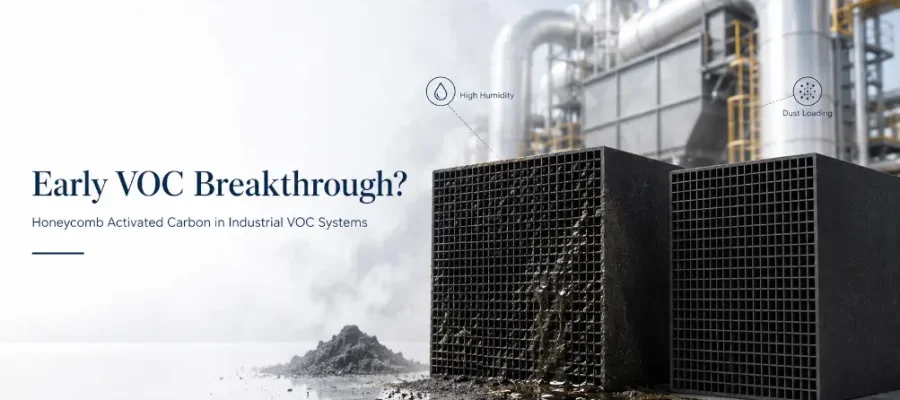
Honeycomb activated carbon is widely used in industrial VOC treatment systems because its structured channels can provide relatively low airflow resistance and convenient installation in filter boxes, adsorption modules, and exhaust-treatment equipment.
However, some users find that honeycomb activated carbon reaches breakthrough much earlier than expected. Odor may return, outlet VOC concentration may rise, or the pressure drop across the system may increase after only a short operating period.
Early failure is not always caused by the honeycomb carbon itself. In many cases, the actual operating condition is not fully matched to the selected product, system design, or pretreatment arrangement.
Understanding the common causes of premature breakthrough can help users reduce replacement frequency, control operating costs, and improve the reliability of industrial VOC treatment systems.
What Does “Early Failure” Mean?
In VOC adsorption systems, early failure usually means that the honeycomb activated carbon loses effective removal performance sooner than the expected replacement cycle.
This may appear in several ways:
- VOC concentration at the outlet begins to rise.
- Solvent or chemical odors become noticeable after the carbon stage.
- Emission-monitoring results show lower removal efficiency.
- Pressure drop increases faster than expected.
- Channels become blocked by dust, paint mist, oil aerosol, or moisture-related deposits.
These signs may indicate adsorption breakthrough, physical blockage, gas bypass, or a combination of several system issues.
1. VOC Concentration Is Higher Than the Original Design Condition
One of the most common causes of early breakthrough is a higher-than-expected VOC load. In some factories, solvent use, production volume, coating formulation, drying temperature, or operating hours may increase after the VOC system is installed.
When the inlet VOC concentration rises, the activated carbon adsorbs pollutants more quickly and reaches saturation sooner. A module designed for low or moderate VOC concentration may not provide sufficient service life under a higher pollutant load.
Sudden process changes can also have a significant effect. For example, switching to a different paint, thinner, cleaning solvent, adhesive, or coating formula may change both VOC concentration and adsorption behavior.
2. Airflow Velocity Is Too High
Honeycomb activated carbon relies on contact between the VOC-containing gas and the activated carbon surface inside the channels. If airflow passes through the honeycomb too quickly, contact time may become too short for effective adsorption.
High face velocity can lead to earlier breakthrough, even when the selected honeycomb activated carbon has suitable adsorption capacity.
In some cases, the blower capacity is increased, additional exhaust points are connected, or the installed carbon area is too small for the actual airflow volume. These changes can raise air velocity through each honeycomb block and reduce overall adsorption efficiency.
Increasing module quantity, enlarging the carbon treatment area, or selecting a suitable honeycomb thickness may help improve gas-contact time and reduce the risk of early failure.
3. Paint Mist, Dust, or Oil Aerosol Blocks the Honeycomb Channels
Honeycomb activated carbon is designed primarily for gas-phase adsorption. It is not intended to directly handle heavy paint mist, dust, oil droplets, or sticky aerosol particles.
When these contaminants enter the honeycomb channels, they may gradually block the airflow path and cover the carbon surface. This reduces the effective adsorption area and increases pressure drop.
In spray booths, printing lines, coating processes, and oil-containing exhaust systems, poor pretreatment is often one of the main reasons for short carbon service life.
Suitable pre-filters, paint-mist filters, demisters, bag filters, or other particle-removal stages should be installed before the honeycomb activated carbon layer.
4. High Humidity Reduces VOC Adsorption Efficiency
Water vapor can compete with VOC molecules for adsorption sites, especially in humid exhaust streams. High humidity may reduce effective adsorption capacity for some organic vapors and can shorten the practical service life of standard honeycomb activated carbon.
Humidity may also contribute to dust accumulation, sticky deposits, or gradual channel blockage when combined with aerosols and process contaminants.
For applications with consistently high humidity, users should evaluate whether upstream moisture control, dehumidification, drainage, or a more suitable water-resistant carbon product is required.
5. The Honeycomb Carbon Grade Is Not Matched to the Pollutant Type
Not all VOCs behave the same way during adsorption. Some vapors are easier to adsorb, while others may require different pore structures, higher carbon loading, greater bed depth, or specialized treatment materials.
A standard honeycomb activated carbon grade may be suitable for many common VOC and odor-control applications, but it may not be the best choice for every mixed-gas condition.
Systems containing formaldehyde, acidic gases, alkaline gases, sulfur compounds, high-boiling solvents, or complex mixed pollutants may require impregnated carbon, catalytic materials, or multi-stage treatment rather than standard honeycomb carbon alone.
6. Carbon Thickness or Adsorption Capacity Is Insufficient
Honeycomb activated carbon is available in different thicknesses, cell densities, and adsorption grades. A thin honeycomb block may provide low pressure drop and easy installation, but it may not contain enough activated carbon for a high VOC load.
Similarly, two products with the same external dimensions may have very different carbon loading and adsorption capacity. Selecting a product based only on CPSI, appearance, or unit price can result in insufficient service life.
For higher VOC concentrations or long operating hours, users may need a thicker honeycomb, more modules, higher carbon loading, or a different adsorption-grade product.
7. Incorrect Installation Direction or Air Bypass
Honeycomb activated carbon should be installed so that airflow passes through the open channels in the intended direction.
If the honeycomb block is installed incorrectly, airflow resistance may increase and the available adsorption path may be reduced. This can negatively affect system performance.
Air bypass is another important issue. If there are gaps between honeycomb modules, damaged frame seals, loose filter housings, or unsealed openings, part of the VOC-containing gas may bypass the carbon layer completely.
In this situation, the outlet VOC concentration may increase even though the activated carbon itself is not yet saturated.
8. Temperature Is Too High
Activated carbon adsorption is generally more favorable at lower temperatures. When exhaust temperature is too high, VOC adsorption capacity may decrease and breakthrough can occur earlier.
High temperature may be found near drying ovens, curing lines, thermal processes, hot coating operations, or poorly cooled exhaust systems.
Where possible, cooling the gas stream before the activated carbon stage can improve adsorption conditions and support more stable performance.
How to Reduce Premature Honeycomb Carbon Failure
To improve the service life of honeycomb activated carbon in VOC systems, users should consider the full treatment process rather than focusing only on the carbon module.
- Confirm actual inlet VOC concentration and pollutant composition.
- Match carbon thickness, adsorption grade, and module quantity to the actual airflow.
- Control face velocity and avoid excessive airflow through each honeycomb block.
- Use suitable pretreatment for dust, paint mist, oil aerosol, and sticky particles.
- Monitor humidity and temperature before the carbon stage.
- Install the honeycomb in the correct airflow direction.
- Check sealing and eliminate bypass gaps between modules.
- Monitor outlet VOC concentration and pressure drop regularly.
- Review the process when coatings, solvents, production volume, or operating hours change.
What Information Should Be Checked Before Replacing Honeycomb Activated Carbon?
When a VOC system experiences early failure, replacing the carbon with the same specification may not solve the root cause. Before ordering replacement honeycomb activated carbon, it is useful to review:
- Current inlet and outlet VOC concentration
- Main solvent, paint, adhesive, or chemical type
- Actual airflow volume and operating hours
- Temperature and humidity of the gas stream
- Existing pre-filtration or paint-mist removal stages
- Current honeycomb dimensions, thickness, CPSI, and carbon grade
- Pressure-drop trend across the carbon section
- Whether visible deposits or channel blockage are present
- Whether process conditions have changed since the last replacement
This information helps identify whether the problem is related to adsorption capacity, airflow, contamination, humidity, installation, or a change in the production process.
HANYAN Support for Industrial VOC Treatment
HANYAN supplies honeycomb activated carbon for industrial VOC treatment, odor control, spray booth exhaust, printing exhaust, coating processes, and other gas-phase purification applications.
For projects experiencing early breakthrough or unstable service life, we can support customers with product-selection discussion, honeycomb dimension confirmation, carbon-grade recommendation, and application-based evaluation.
Providing complete operating information before replacement can help select a honeycomb activated carbon solution that is better matched to actual airflow, pollutant load, and pretreatment conditions.
Conclusion
Early honeycomb activated carbon failure is usually caused by a mismatch between the carbon system and the actual operating condition. High VOC load, excessive airflow velocity, poor pretreatment, humidity, high temperature, unsuitable carbon grade, insufficient thickness, and air bypass can all shorten service life.
By reviewing the full VOC treatment system and selecting honeycomb activated carbon based on actual pollutant conditions, users can reduce premature replacement, improve VOC removal performance, and maintain more stable long-term operation.
Article Keywords: honeycomb activated carbon failure, honeycomb carbon VOC breakthrough, activated carbon VOC filter replacement, industrial VOC filter maintenance, honeycomb activated carbon service life, VOC adsorption failure, honeycomb carbon replacement