
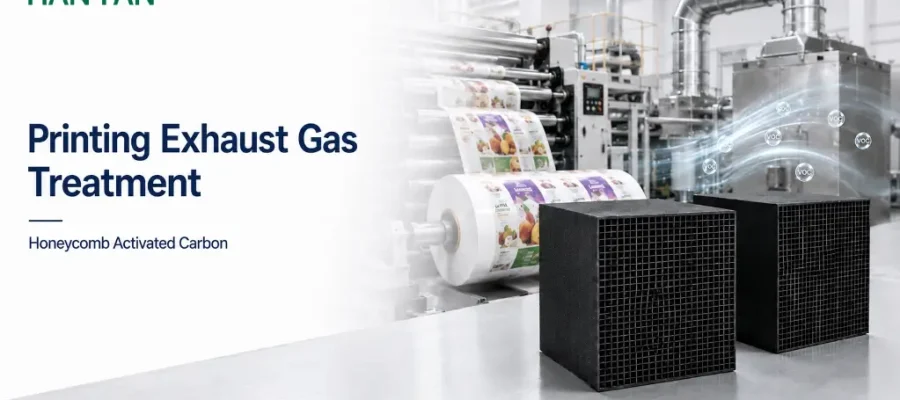
Printing and packaging production lines often generate exhaust gas containing volatile organic compounds (VOCs), solvent vapors, and process odors. These emissions may come from ink application, coating, lamination, drying, curing, cleaning, and solvent storage areas.
For many printing exhaust gas treatment systems, honeycomb activated carbon is used as a compact adsorption material for VOC and odor control. Its straight-through channel structure helps air pass through the carbon block with relatively low resistance, making it suitable for high-airflow exhaust systems commonly found in printing and packaging facilities.
However, successful VOC control depends on more than installing activated carbon. The printing process, exhaust concentration, airflow volume, temperature, humidity, solvent type, and pretreatment conditions should all be considered before selecting a honeycomb activated carbon grade.
Where VOCs Come From in Printing and Packaging Lines
Printing exhaust gas can be generated from several process points. The exact composition depends on the ink system, printing method, production speed, drying temperature, and raw materials used in the facility.
Common VOC and odor sources include:
- Solvent-based inks
- Ink thinners and diluents
- Adhesives used in lamination or composite packaging
- Surface coatings and varnishes
- Cleaning solvents for rollers, plates, and equipment
- Drying ovens and hot-air exhaust sections
- Ink mixing, storage, and transfer areas
In packaging printing, solvent vapors may be released continuously during production, especially from gravure printing, flexographic printing, coating, and lamination processes. These exhaust streams often require collection and treatment before discharge.
Why Honeycomb Activated Carbon Is Used for Printing Exhaust Gas
Printing exhaust systems often involve large air volumes and relatively low to medium VOC concentrations. In such cases, the treatment material should provide sufficient adsorption contact while keeping airflow resistance within a practical range.
Honeycomb activated carbon offers several advantages for this type of application:
- Low pressure drop due to straight-through channels
- Suitable for modular installation in filter boxes or adsorption cabinets
- Stable block shape for easy handling and replacement
- Useful adsorption performance for many solvent vapors and odors
- Flexible dimensions and thickness options for different equipment designs
- Better airflow distribution compared with some loose-fill carbon arrangements
Because of these features, honeycomb activated carbon is often considered for printing exhaust gas treatment where compact installation, airflow stability, and convenient maintenance are important.
Common Printing Applications for Honeycomb Carbon
Honeycomb activated carbon may be used in different printing and packaging exhaust-treatment scenarios, such as:
- Flexible packaging printing lines
- Gravure printing exhaust
- Flexographic printing exhaust
- Label printing and coating processes
- Lamination and adhesive exhaust
- Ink drying and curing exhaust
- Solvent odor control in packaging workshops
The suitable carbon grade and system design should be selected according to the actual solvent composition and operating condition, rather than based only on a general “printing VOC” description.
Key Factors That Affect VOC Adsorption Performance
1. Solvent Type and VOC Composition
Different solvents have different adsorption behavior on activated carbon. Aromatic solvents, esters, ketones, alcohols, and mixed solvent systems may not be adsorbed with the same efficiency or service life.
When available, buyers should provide information about ink type, adhesive type, cleaning solvent, safety data sheets, or known VOC components. This helps the supplier recommend a more suitable honeycomb activated carbon grade.
2. Inlet VOC Concentration
Higher inlet concentration means the activated carbon adsorbs pollutants faster and may reach breakthrough sooner. If the printing line runs at high production speed or uses a large amount of solvent-based ink or adhesive, the VOC load may increase significantly.
For stable operation, the selected honeycomb carbon quantity and thickness should be matched to the actual VOC load, not only to the external size of the equipment.
3. Airflow Volume and Contact Time
Printing exhaust systems usually require strong ventilation and high air exchange. If airflow passes through the honeycomb carbon too quickly, contact time may be insufficient, leading to lower removal efficiency or earlier breakthrough.
Designers should consider total airflow, face velocity, module area, honeycomb thickness, and the number of installed blocks to maintain a practical balance between adsorption performance and pressure drop.
4. Temperature and Humidity
Exhaust from drying ovens or hot-air sections may have elevated temperature. Higher gas temperature can reduce adsorption performance and shorten service life in some VOC systems.
Humidity is another important factor. Water vapor may compete with organic vapors for adsorption sites and may also contribute to sticky deposits when combined with ink mist, dust, or aerosol particles.
For high-temperature or high-humidity exhaust streams, cooling, moisture control, or a more suitable carbon grade should be considered before the gas reaches the activated carbon stage.
5. Ink Mist, Dust, and Sticky Aerosols
Honeycomb activated carbon is designed mainly for gas-phase adsorption. It should not be used as the first barrier for heavy ink mist, dust, oil aerosol, or sticky particles.
If these contaminants enter the honeycomb channels, they can block airflow passages and cover the carbon surface. This may increase pressure drop, reduce adsorption efficiency, and shorten the replacement cycle.
For printing exhaust systems, suitable pre-filtration is strongly recommended before the honeycomb activated carbon layer.
Importance of Pretreatment Before Activated Carbon
Pretreatment is especially important in printing and packaging exhaust gas treatment. Depending on the process, the pretreatment stage may include:
- Primary filters for dust and larger particles
- High-efficiency filters for fine particulates
- Demisters for moisture or aerosol removal
- Cooling units for high-temperature exhaust
- Oil-mist or sticky-particle control when needed
Good pretreatment helps protect the honeycomb channels from blockage and allows VOC-containing gas to contact the activated carbon more effectively. This can improve service life and reduce the risk of premature replacement.
How to Select Honeycomb Activated Carbon for Printing VOC Treatment
When selecting honeycomb activated carbon for a printing exhaust system, buyers should not rely only on block size or CPSI. The actual operating condition is more important.
Useful information for selection includes:
- Printing process type, such as gravure, flexographic, coating, or lamination
- Main ink, solvent, adhesive, or cleaning-agent type
- Known VOC concentration or emission data
- Total exhaust airflow volume
- Operating temperature and humidity
- Available installation space and module dimensions
- Existing pre-filtration or pretreatment equipment
- Target outlet concentration or odor-control requirement
- Daily operating hours and expected replacement cycle
With this information, the supplier can recommend a more suitable honeycomb size, thickness, cell density, adsorption grade, and module arrangement.
When Standard Honeycomb Carbon May Not Be Enough
Standard honeycomb activated carbon can be suitable for many common VOC and odor-control applications. However, some printing exhaust streams may require additional evaluation.
Special attention is needed when the exhaust contains:
- Very high VOC concentration
- High-boiling or difficult-to-adsorb solvent mixtures
- High humidity or high temperature
- Sticky ink mist or adhesive aerosol
- Acidic, alkaline, or chemically reactive gases
- Strong odor compounds that require targeted adsorption
In these cases, the system may need enhanced pretreatment, greater carbon loading, increased module area, thicker honeycomb blocks, or a different carbon grade. For some high-concentration processes, activated carbon may also be used as part of a combined treatment system rather than the only control technology.
How to Monitor Replacement Timing
The replacement cycle of honeycomb activated carbon in printing exhaust systems depends on VOC load, airflow, operating time, solvent type, humidity, temperature, and pretreatment efficiency.
Common signs that replacement may be needed include:
- Outlet VOC concentration begins to increase
- Solvent odor becomes noticeable after the carbon stage
- Pressure drop rises due to channel contamination
- Emission test results show reduced removal performance
- Honeycomb channels show visible dust, oil, ink mist, or sticky deposits
- Operating time reaches the expected replacement plan
Monitoring both VOC outlet concentration and pressure drop can help users distinguish between adsorption breakthrough and physical blockage.
HANYAN Honeycomb Activated Carbon for Printing Exhaust Applications
HANYAN supplies honeycomb activated carbon for industrial VOC treatment, odor control, printing exhaust, coating lines, spray booths, and other gas-phase purification applications.
For printing and packaging exhaust systems, we can support customers with honeycomb dimension confirmation, cell-density discussion, adsorption-grade recommendation, and customized specifications based on airflow and pollutant conditions.
If your printing exhaust system is facing solvent odor, unstable VOC removal, high pressure drop, or short replacement cycles, sharing the complete operating condition can help us recommend a more suitable honeycomb activated carbon solution.
Conclusion
Honeycomb activated carbon can be a practical adsorption material for VOC and odor control in printing exhaust gas treatment. Its structured channels support relatively low pressure drop and convenient modular installation, making it suitable for many packaging printing and industrial printing applications.
To achieve stable performance, users should consider VOC composition, airflow volume, contact time, temperature, humidity, pretreatment, carbon thickness, and replacement monitoring together. A well-matched honeycomb activated carbon system can help reduce solvent odor, improve exhaust-gas treatment stability, and support cleaner printing production.
Article Keywords: honeycomb activated carbon for printing exhaust, activated carbon for printing VOC treatment, printing exhaust gas treatment, packaging printing VOC adsorption, activated carbon for ink odor removal, honeycomb carbon for solvent vapor, printing VOC filter