

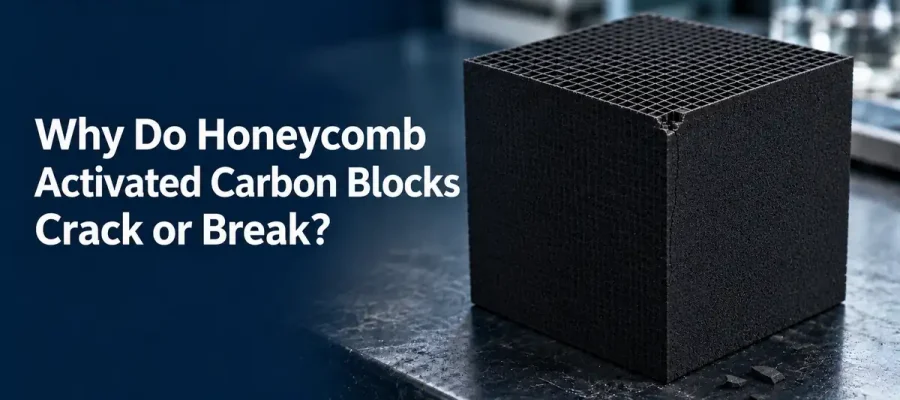
A chipped corner is found when a carton is opened. A carbon block develops a crack during installation. Another adsorption unit appears loose carbon fragments after several weeks of operation. Although these situations all involve physical damage, they may have different causes.
Honeycomb activated carbon cracking should be assessed using the damage pattern, when it first appeared, and the conditions the block experienced. Material quality matters, but transport, installation, storage, and operating conditions also need investigation. The purpose is to identify the cause and prevent recurrence.
Contents
- Distinguish chipping, cracking, and widespread breakage
- Material strength and manufacturing factors
- Transport and handling damage
- Installation pressure and inadequate support
- Moisture and unsuitable exposure
- Vibration and temperature changes during operation
- How to investigate damage
- How to reduce the risk of breakage
1. Distinguish Chipping, Cracking, and Widespread Breakage
Start by describing the damage precisely. A small edge chip, a crack extending across a block, and material that crumbles throughout its structure are different observations.
The table below lists investigation priorities, not confirmed diagnoses. Several causes can lead to similar visible damage.
| Observation | What to investigate first |
|---|---|
| Localized corner or edge chips | Impacts, rubbing between blocks, packing arrangement, and handling records. |
| A crack across the block | Earlier hidden damage, uneven support, installation forces, and material integrity. |
| Damage where a block contacts its frame | Fit, contact points, retaining hardware, and local compression. |
| Repeated fragments or dust after startup | Block movement, vibration, rubbing, existing cracks, and operating changes. |
| Softening or crumbling after wet exposure | Grade suitability, liquid contact, packaging condition, and upstream moisture sources. |
A small chip does not establish that adsorption capacity has changed, but its location may still affect sealing or support. Likewise, a block that retains its overall shape is not necessarily suitable for continued use if a crack compromises its installation.
2. Material Strength and Manufacturing Factors
Honeycomb activated carbon combines an adsorbing material with a load-bearing channel structure. Formulation, forming conditions, and subsequent processing can influence the finished monolith’s mechanical properties.
For example, research on activated carbon–LDPE honeycomb monoliths reported different mechanical properties for extrusion and conventional press molding. This is evidence from a specific formulation, rather than a specification for every commercial honeycomb carbon. It supports evaluating the finished product instead of inferring strength from its appearance or raw carbon alone.
If a material issue is suspected, compare affected blocks with retained or unopened samples from the same batch. Review the agreed dimensional and strength requirements, the test procedure, and whether the damage is isolated or repeated across several cartons.
CTC adsorption and iodine number are not mechanical-strength tests. Strong adsorption results do not replace an agreed evaluation of block integrity.
Also distinguish granular hardness from honeycomb compressive strength. ASTM D3802-23 addresses ball-pan hardness of granular activated carbon. It does not provide an intact honeycomb block compression result. For block testing, agree on specimen size, conditioning, loading direction, and the way stress or breaking load is reported.
3. Transport and Handling Damage
Even a block that meets its agreed strength requirement can be damaged by an impact or concentrated load. When damage is noticed on arrival, review both the product and the packaging.
Questions worth checking include whether cartons were crushed, internal separators moved, blocks could strike one another, or pallet stacking transferred weight unevenly. Damage concentrated in one corner of a carton suggests a different investigation from similar cracks found in protected blocks across several cartons.
During unpacking, support blocks from underneath and avoid dragging their edges across hard surfaces. Do not use the channel walls as lifting points. Follow the supplier’s packaging and stacking instructions rather than assuming one arrangement suits every block size.
Photograph the unopened package and the arrangement inside it before moving the damaged pieces. Our honeycomb activated carbon receiving checklist can help organize those records.
4. Installation Pressure and Inadequate Support
A close-fitting installation needs controlled support and sealing. Forcing a block into an undersized frame, tightening a retainer against an edge, or placing it on an uneven support can concentrate the load.
Check the actual dimensions of the blocks and housing against the approved arrangement. Confirm that supports are level, retaining hardware contacts the intended areas, and seals are compatible with the operating conditions.
Where blocks are stacked, the support design should account for the installed load. Avoid using the carbon itself to correct a misaligned housing or to carry loads outside its agreed design.
Sealing also needs attention because physical damage can create unintended gas paths. The supplier and equipment designer should review the arrangement together; see our guide to preventing air bypass for related installation considerations.
5. Moisture and Unsuitable Exposure
Moisture exposure should be investigated when the material becomes soft or loses integrity, but do not assume every honeycomb grade responds in the same way. The effect depends on the formulation, treatment, and exposure conditions.
Cefic’s Activated Carbon Producers Association recommends protecting activated carbon from moisture during storage to maintain its technical properties. For honeycomb blocks, check packaging, floor contact, leaks, condensation, and liquid droplets entering from upstream equipment.
A description such as “water-resistant” should be tied to an agreed test or service condition. It should not automatically be interpreted as approval for immersion, steam exposure, washing, or repeated wetting and drying.
If wetting is suspected, preserve the evidence and discuss the exposure with the supplier. Avoid an improvised soaking or heating test that changes the sample before assessment.
6. Vibration and Temperature Changes During Operation
If blocks were intact at installation but damage developed later, review the operating history. Check whether blocks can move against each other or their frame, and whether vibration is transmitted from fans or other equipment.
For a heated or regenerated system, review temperature records, heating and cooling sequences, and any uneven exposure. Temperature changes and constrained expansion are possible investigation points, but a visible crack alone cannot establish thermal stress as the cause.
Use the approved operating envelope for the specific grade and system. Neither the manufacturing temperature nor a regeneration setting used for another product establishes an acceptable operating condition for the installed blocks.
7. How to Investigate Honeycomb Activated Carbon Damage
A useful assessment separates the timeline from the possible causes. Record what was observed first, then compare it with the transport, installation, and operating records.
| Evidence to retain | Why it helps |
|---|---|
| Batch labels, specifications, and delivery records | Connect the affected material with the agreed product and shipment. |
| Photos before unpacking, installation, and operation | Help establish when damage first became visible. |
| Number and location of affected blocks | Show whether damage follows a packaging, support, or equipment pattern. |
| Retained blocks and fragments | Allow comparison without relying only on photographs. |
| Housing dimensions, supports, and retaining details | Help assess fit and concentrated loads. |
| Moisture, temperature, maintenance, and operating records | Help identify changes before the damage appeared. |
Keep affected pieces separate and avoid modifying them before examination. Where mechanical testing is needed, agree on representative sampling and a common procedure before comparing results.
Do not assign a universal acceptable chip size or crack length without considering the specification, seal, support, and gas path. The equipment designer and supplier should assess whether affected blocks can be used or require replacement.
8. How to Reduce the Risk of Breakage
A practical prevention plan covers the product and its full handling route:
- Agree on finished-block dimensions, mechanical requirements, and inspection criteria before purchase.
- Use packaging and stacking arrangements appropriate for the block size and shipment.
- Protect stored material from moisture and keep the packaging intact until needed.
- Support blocks evenly and verify frame fit before installation.
- Use the specified seals and retainers without forcing or locally crushing the carbon.
- Review abnormal vibration, liquid carryover, and changes to heated operating cycles.
Damage should trigger an evidence-based review of material quality and service conditions. Replacing blocks without addressing an installation or operating cause can leave the same problem in place. Equally, a suspected manufacturing issue deserves a batch-level assessment rather than being dismissed as handling damage.
At HANYAN, we welcome discussions about your honeycomb dimensions, adsorption requirements, operating conditions, and packaging needs. If damage occurs, share the batch details, photographs, affected quantity, and installation information so we can discuss the product assessment and suitable next steps.
References
- Lim, J. W., et al. (2010). Extrusion of honeycomb monoliths employed with activated carbon-LDPE hybrid materials. Journal of Industrial and Engineering Chemistry, 16(1), 51–56. Research on a specific formulation; not a universal commercial product specification.
- ASTM D3802-23: Standard Test Method for Ball-Pan Hardness of Activated Carbon. Public scope and significance statements.
- Cefic / Activated Carbon Producers Association: Handling & Storage.
Article Keywords: honeycomb activated carbon cracking, honeycomb activated carbon breakage, honeycomb carbon compressive strength, honeycomb carbon handling, honeycomb carbon installation, honeycomb activated carbon quality