
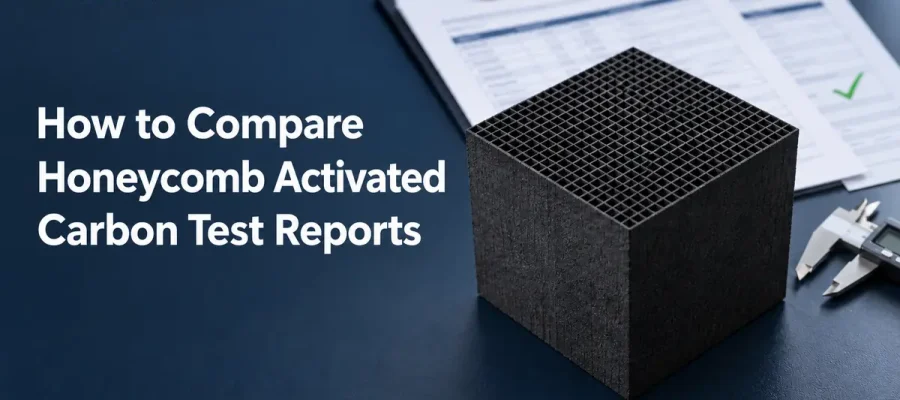
Two suppliers offer honeycomb activated carbon with similar CTC adsorption values and iodine numbers. Both provide a test report. Does that mean the products are equivalent?
Before comparing the numbers, check what was tested and how the results were obtained. Honeycomb activated carbon test reports are most useful when sample identity, test methods, units, and reporting conditions are clear. A higher value on an incomplete report may be less informative than a slightly lower value supported by a well-defined test.
This guide explains how buyers can review reports more consistently and identify questions to resolve before placing an order.
Contents
- Identify the document and the batch
- Confirm what sample was tested
- Check methods and their applicability
- Compare units and reporting basis
- Read structural and strength results correctly
- A practical report comparison example
- Review the laboratory and sampling arrangements
- Connect laboratory results with the application
1. Identify the Document and the Batch
Start by distinguishing a product specification, a certificate of analysis (COA), and a laboratory test report. A specification describes agreed requirements or typical properties. A batch COA records results or conformity information for an identified batch. A laboratory report describes the submitted sample and the tests performed.
Do not assume every number on a datasheet is a measured result for the shipment being offered. Ask whether each entry is a minimum requirement, a typical value, an actual batch result, or a pass/fail statement.
For procurement, request a clear connection between the report, product grade, purchase specification, and batch label. An older report may help characterize a grade, but does not by itself establish the properties of a new production batch.
2. Confirm What Sample Was Tested
For honeycomb products, a sample description such as “activated carbon” leaves important questions unanswered. Ask whether the laboratory received raw carbon powder, material taken from a finished honeycomb block, or an intact block.
Also clarify whether the sample was dried, crushed, ground, or otherwise prepared before testing. Preparing a finished-block sample for an analytical method is different from substituting the original raw powder. Sample preparation can be appropriate, but the source of the material must remain traceable.
A raw-material result should not automatically be presented as a finished-product result. For a formed product containing binder or other constituents, ask whether the reported value applies to the complete finished material or a separately defined carbon fraction.
3. Check the Test Method and Its Applicability
Request the method identifier and edition, together with any deviations or agreed internal procedures. Different methods are not automatically invalid, but results obtained by different procedures should not be treated as directly interchangeable without a technical review.
CTC Adsorption
ASTM D3467-04(2020) describes carbon tetrachloride activity as the mass of CTC adsorbed relative to the sample mass, expressed as a percentage under specified test conditions. Its public description also explains that the result does not necessarily predict performance with other adsorbates or operating conditions.
When comparing CTC values, check the method, sample preparation, and stated mass basis. A report should make clear what a quoted “CTC 70%” represents; it is not a claim of 70% VOC removal efficiency.
Iodine Number
ASTM D4607-14(2021) treats iodine number as a relative indicator of porosity. Its public description cautions against using it as a general prediction of adsorption for other substances.
Use iodine number to compare a defined property under an agreed method. Do not convert it directly into a guaranteed solvent capacity, VOC removal percentage, or replacement interval.
4. Compare Units and Reporting Basis
A valid comparison requires more than matching column headings. Confirm what the denominator represents and whether results are reported on a dry basis or an as-received basis.
| Reported item | What to clarify |
|---|---|
| CTC adsorption, % | Test method, sample preparation, and mass basis; distinguish adsorption activity from gas removal efficiency. |
| Iodine number, mg/g | Method and sample identity; confirm whether the result describes finished material. |
| Moisture, % | Procedure, sample condition, and timing relative to packaging or storage. |
| Block density, g/cm³ or kg/m³ | Whether volume includes the open channels and whether the mass is dry or as received. |
| Compressive strength, MPa | Specimen dimensions, loading direction, conditioning, and area used to calculate stress. |
| Breaking load, N | Specimen geometry and procedure; force alone is not the same quantity as compressive stress. |
Moisture deserves particular attention when discussing sample mass. ASTM D2867-23 identifies moisture determination as relevant to expressing activated carbon properties relative to net carbon weight. Keep the measurement basis consistent rather than applying an improvised correction to an unfamiliar test.
5. Read Structural and Strength Results Correctly
CPSI, external dimensions, channel dimensions, and wall thickness describe different aspects of a honeycomb block. Matching CPSI does not establish identical geometry. For structural comparisons, request the agreed dimensional tolerances as well as the nominal values.
For mechanical performance, the word “hardness” is especially easy to misread. ASTM D3802-23 concerns ball-pan hardness of granular activated carbon. A granular hardness percentage cannot replace a defined compression test for an intact honeycomb block.
When reviewing compression results, ask how the channels were oriented relative to the load, whether the entire block or a cut specimen was tested, and how many specimens were measured. Request the individual results or range where available, not just an unexplained average.
6. A Practical Report Comparison Example
The following example is hypothetical and illustrates missing information rather than ranking real suppliers.
| Report entry | Supplier A | Supplier B |
|---|---|---|
| CTC result | 70%; method and preparation documented | 75%; procedure not identified |
| Sample description | Finished block from an identified production batch | “Activated carbon”; source unclear |
| Mechanical result | Compressive strength with specimen and loading details | “Hardness 95%”; procedure not identified |
| Batch connection | Report linked to offered batch | No batch reference |
Supplier B’s higher CTC figure is a reason to request clarification, not enough evidence to declare the product better or worse. Ask for the missing method, sample, and batch information before making a purchasing decision.
7. Review the Laboratory and Sampling Arrangements
Internal quality-control testing and independent laboratory testing can serve different purposes. For either route, check who selected the sample, how it was identified, and which tests the report actually covers.
If accredited testing is required, verify the laboratory’s relevant scope rather than relying on its logo alone. ILAC’s guidance explains that accredited testing activities are defined by the laboratory’s scope of accreditation. Laboratory accreditation is not a blanket certification of every product or every test listed in a supplier’s brochure.
For a disputed result, a useful approach is to agree on a representative sample, divide it into sealed portions, and arrange testing under the same agreed procedure. Differences between results should be reviewed with the laboratories before attributing them to product inconsistency.
8. Connect Laboratory Results with the Application
A material-property report and a performance test of a complete filter answer different questions. For example, ISO 10121-2:2013 addresses full-size gas-phase air-cleaning devices for general ventilation. Its scope should not be treated as a universal qualification for every industrial VOC process.
For an application-specific comparison, agree on the target gas, inlet concentration, temperature, humidity, airflow, specimen geometry, and performance endpoint. A removal-efficiency figure without these details gives an incomplete basis for comparison.
You can also connect the report review with our guide to VOC mixtures and honeycomb activated carbon performance, particularly when the operating stream contains several solvents.
Before approving a supplier, confirm four things: the right sample, a suitable method, a consistent reporting basis, and a traceable batch. These checks make honeycomb activated carbon test reports more useful for selecting products and agreeing on acceptance requirements.
At HANYAN, we welcome discussions about your required honeycomb dimensions, adsorption indicators, testing methods, and batch documentation. Share your current specification and operating conditions so we can discuss suitable product options and the information needed for a meaningful comparison.
References
The references below link to public scope or explanatory pages. They do not imply that every listed method applies unchanged to an intact honeycomb block, or that HANYAN is accredited to perform every referenced test. Complete standards should be consulted when agreeing on a testing procedure.
- ASTM D3467-04(2020): Carbon Tetrachloride Activity of Activated Carbon.
- ASTM D4607-14(2021): Determination of Iodine Number of Activated Carbon.
- ASTM D2867-23: Moisture in Activated Carbon.
- ASTM D3802-23: Ball-Pan Hardness of Activated Carbon.
- ILAC: Frequently Asked Questions about laboratory accreditation.
- ISO 10121-2:2013: Gas-phase air-cleaning devices for general ventilation.