
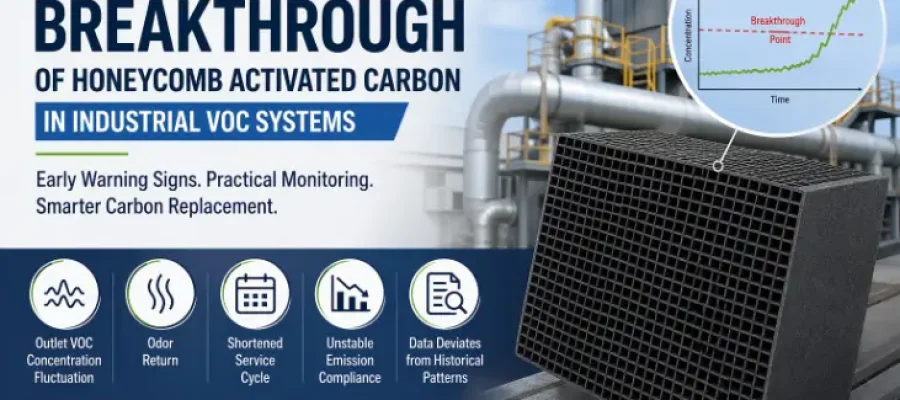
In industrial VOC treatment systems, one of the most important questions is not simply whether honeycomb activated carbon can adsorb pollutants, but when the adsorbent is approaching breakthrough and how operators can recognize it before emissions become unstable.
In practice, many customers assume that activated carbon works normally until it suddenly “fails.” However, breakthrough is usually a gradual process rather than an instant event. Before the adsorbent is fully saturated, the system often shows early warning signs such as outlet concentration fluctuation, odor return, reduced treatment stability, or a shorter-than-expected service cycle.
Understanding these signals can help operators replace activated carbon more reasonably, maintain emission compliance, and reduce the risk of unexpected performance loss.
What Does Breakthrough Mean in a VOC Adsorption System?
Breakthrough refers to the point at which a VOC adsorption bed can no longer retain pollutants effectively at the required level, and contaminants begin to appear at the outlet in increasing amounts.
It is important to note that breakthrough does not always mean the honeycomb activated carbon is completely exhausted. In many industrial systems, the practical replacement point comes earlier than full saturation. This is because the system is designed to meet a target outlet concentration, odor standard, or emission requirement. Once the outlet performance starts to drift beyond the acceptable range, the carbon may already be considered unsuitable for continued use in that application.
In other words, breakthrough should be judged by system performance under actual operating conditions, not only by whether the carbon still has some remaining adsorption capacity in theory.
Common Signs That Breakthrough May Be Approaching
In real industrial operation, breakthrough is often first noticed through changes in performance rather than laboratory analysis. The following signs are among the most common:
1. Outlet VOC concentration starts to fluctuate
If the inlet load remains relatively stable but the outlet concentration becomes more variable, this may indicate that the adsorption bed is losing its buffering capacity. In many cases, breakthrough does not begin as a dramatic spike. It may start as small fluctuations that become more frequent over time.
2. Odor begins to return
In systems where odor control is an important objective, a noticeable return of smell can be one of the earliest practical warning signs. Even if analytical data has not yet shown a major increase, operators or nearby personnel may already detect a change in odor performance.
3. The replacement cycle becomes shorter
If the carbon used to last for a predictable period but now requires earlier replacement, the system may be reaching breakthrough faster than before. This often indicates that operating conditions have changed, such as higher VOC concentration, higher humidity, temperature variation, or insufficient pretreatment.
4. Emission compliance becomes less stable
Some systems continue to perform acceptably most of the time, but occasionally fail during peak loads, line startups, or process changes. This type of instability can be a sign that the remaining adsorption margin is already limited.
5. Monitoring data no longer matches historical patterns
When a system has established baseline data, deviation from the usual trend can be very informative. If the same carbon type under the same process used to perform consistently but now behaves differently, breakthrough risk should be evaluated rather than assuming the change is random.
Why Breakthrough Does Not Happen at the Same Time in Every System
There is no universal rule for exactly when honeycomb activated carbon will break through, because actual service life depends on far more than the adsorbent itself. The same product can behave very differently under different plant working conditions.
Several factors can accelerate breakthrough:
- Higher inlet VOC concentration – increases the adsorption load on the carbon bed.
- Larger air volume – may reduce effective contact time if the system is not well matched.
- Humidity – moisture can compete with target compounds and reduce effective adsorption performance.
- Temperature fluctuation – adsorption behavior can change as operating temperature rises or varies.
- Mixed contaminants – different VOC components may compete for adsorption sites.
- Dust or oil mist – contaminants can block pore access or foul the carbon surface.
- Unstable operation – startup peaks, intermittent discharge, or sudden load changes may lead to earlier local saturation.
For this reason, breakthrough should always be evaluated in the context of the full VOC treatment system rather than by a single product parameter alone.
How to Monitor Breakthrough More Effectively
For industrial customers, the most practical approach is not to wait for complete failure, but to identify breakthrough trends early through routine monitoring and disciplined record keeping.
1. Track outlet performance regularly
Routine outlet sampling, online VOC monitoring, or scheduled emission checks can help operators identify abnormal trends before they become serious. Even if continuous monitoring is not available, periodic comparison against historical values is useful.
2. Keep operating records
Replacement date alone is not enough. It is better to record:
- inlet concentration range
- airflow conditions
- temperature and humidity
- production schedule changes
- odor complaints or abnormal observations
- actual replacement cycle length
These records make it much easier to distinguish true breakthrough from temporary process fluctuation.
3. Compare performance under similar workloads
A carbon bed should not be judged only during light-load operation. Systems often appear normal under mild conditions but show breakthrough during peak production. Comparing data under comparable process loads gives a more reliable assessment.
4. Pay attention to pretreatment condition
If filters, demisters, or upstream pretreatment units are not functioning properly, honeycomb activated carbon may appear to fail early when the real cause is system contamination or moisture carryover. In such cases, replacing the carbon alone may not solve the root problem.
5. Establish a practical replacement threshold
Instead of waiting for severe emission failure, many users benefit from defining an internal action point, such as a concentration trend, odor threshold, or operating cycle target. This makes maintenance more predictable and reduces the chance of unexpected shutdown or non-compliance.
Breakthrough Is a System Signal, Not Just a Carbon Signal
One common misunderstanding is to treat breakthrough as a simple indicator of carbon quality. In reality, breakthrough reflects the interaction between carbon properties, contaminant profile, airflow design, pretreatment effectiveness, and operating stability.
A high-performing honeycomb activated carbon can still break through early if the system experiences heavy humidity, concentration spikes, or inadequate front-end protection. On the other hand, a well-matched system with stable conditions may achieve a much longer and more predictable service cycle.
This is why practical engineering judgment is often more valuable than relying on a single lab number when evaluating adsorption performance.
Conclusion
To identify breakthrough of honeycomb activated carbon in industrial VOC systems, users should not wait until the adsorbent is fully exhausted or the system obviously fails. In many cases, early warning signs appear first through outlet concentration fluctuation, odor return, unstable compliance, or shortened replacement cycles.
The key is to evaluate performance under actual operating conditions and build a monitoring routine that combines system data, process observations, and maintenance records. A more accurate understanding of breakthrough helps users replace carbon at the right time, improve treatment stability, and manage operating cost more effectively.
For industrial VOC control, better results usually come not only from choosing the right honeycomb activated carbon, but also from understanding how the entire system behaves over time.
Article Keywords: honeycomb activated carbon breakthrough, VOC adsorption system, industrial VOC treatment, activated carbon replacement timing, honeycomb carbon performance, breakthrough monitoring, exhaust gas treatment, VOC control system