

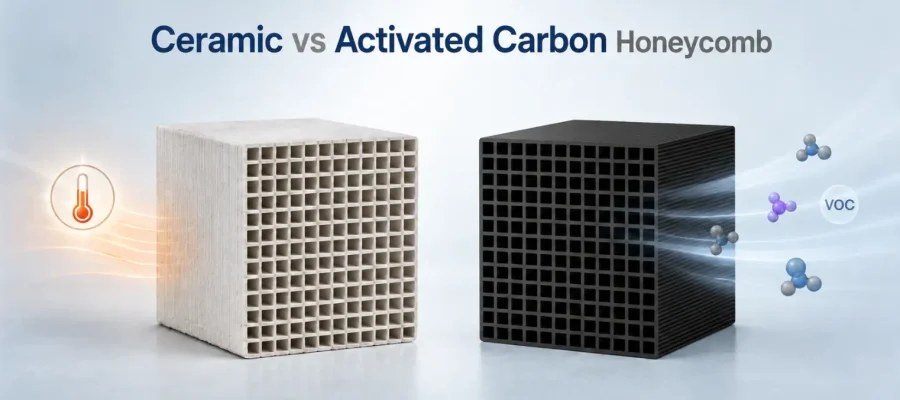
In air purification systems, honeycomb-structured materials are widely used because they provide straight airflow channels, relatively low pressure drop, and compact installation advantages. Among them, ceramic honeycombs and activated carbon honeycombs are two common materials that may look similar in shape, but their functions and application logic are very different.
Ceramic honeycombs are often used as structural substrates or catalyst carriers, especially in high-temperature or catalytic treatment systems. Activated carbon honeycombs, on the other hand, are designed for adsorption. They are widely used for VOC removal, odor control, and industrial gas-phase filtration.
As more air purification projects focus on normal-temperature VOC adsorption, low-to-medium concentration waste gas treatment, and energy-saving system design, activated carbon honeycomb has become a more adaptable option in many practical applications.
What Is a Ceramic Honeycomb?
A ceramic honeycomb is usually made from inorganic ceramic materials such as cordierite, alumina, or other heat-resistant materials. It has a uniform channel structure and good thermal stability, making it suitable for applications where high temperature resistance and mechanical strength are required.
In air treatment systems, ceramic honeycombs are commonly used as catalyst carriers. The ceramic body itself does not mainly work by adsorption. Instead, it provides a stable structure for catalytic coatings, helping support oxidation, decomposition, or conversion reactions under suitable process conditions.
Therefore, ceramic honeycomb is more closely related to catalytic treatment, thermal processes, and exhaust gas conversion systems, rather than direct VOC adsorption.
What Is an Honeycomb Activated Carbon?
Honeycomb activated carbon is made from activated carbon material formed into a honeycomb structure. Its main function is adsorption. With a developed pore structure and large surface area, honeycomb activated carbon can capture VOCs, solvent vapors, odors, and certain gaseous pollutants from the air stream.
Compared with granular activated carbon beds, honeycomb activated carbon has straight channels that help reduce airflow resistance. This makes it especially suitable for large-air-volume systems where low pressure drop and stable gas flow are important.
For many industrial air purification applications, honeycomb activated carbon provides a more direct and practical solution because it can be installed as an adsorption media without requiring high-temperature reaction conditions or catalytic activation.
Core Difference: Structural Carrier vs Adsorption Media
The biggest difference between ceramic honeycomb and activated carbon honeycomb is their role in the system. Ceramic honeycomb is usually a carrier or substrate, while activated carbon honeycomb is the functional adsorption material itself.
| Comparison Item | Ceramic Honeycomb | Honeycomb Activated Carbon |
|---|---|---|
| Main Role | Structural substrate or catalyst carrier | Functional adsorption media |
| Working Principle | Usually depends on catalyst coating and reaction conditions | Relies on pore structure and physical adsorption |
| Typical Pollutants | Pollutants suitable for catalytic oxidation or conversion | VOCs, odors, solvent vapors, and gaseous pollutants |
| Operating Temperature | Suitable for high-temperature environments | More suitable for normal-temperature or controlled-temperature systems |
| Application Flexibility | More dependent on system conditions and catalyst design | Broader adaptability for VOC and odor adsorption projects |
| Maintenance Focus | Catalyst activity, fouling, and thermal stability | Adsorption saturation, replacement cycle, and pressure drop |
Why Honeycomb Activated Carbon Has Broader Adaptability Today
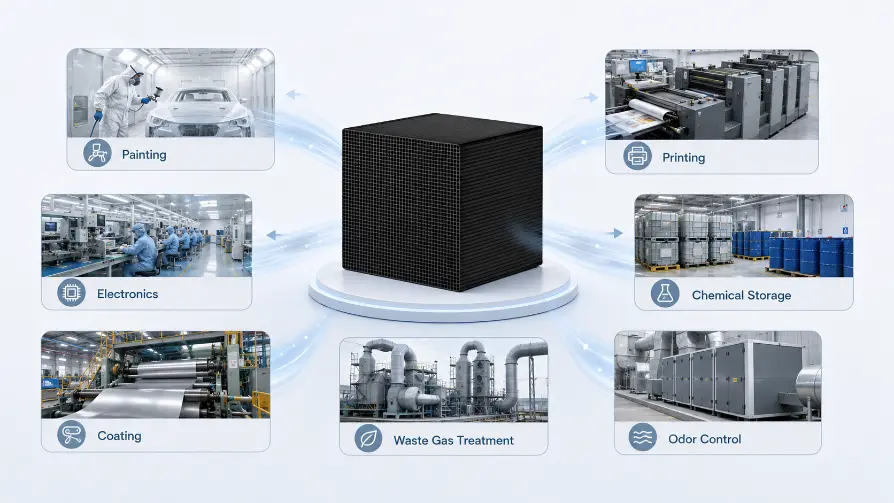
In many current air purification projects, the target pollutants are VOCs, odors, or mixed organic gases at low to medium concentrations. These conditions are commonly found in painting workshops, printing facilities, electronics manufacturing, chemical storage areas, coating lines, waste gas treatment systems, and odor control projects.
For these scenarios, activated carbon honeycomb is often more adaptable because it directly targets gas-phase pollutants through adsorption. It does not require the system to reach a specific reaction temperature, nor does it rely on light intensity or catalytic reaction conditions.
This makes activated carbon honeycomb easier to integrate into many existing air purification systems, especially when the project requires simple installation, relatively low pressure drop, and stable adsorption performance under normal operating temperatures.
VOC and Odor Removal: Honeycomb Activated Carbon Is More Direct
When the main goal is VOC adsorption or odor control, honeycomb activated carbon is usually the more direct choice. Its pore structure can adsorb a wide range of organic compounds, making it suitable for many industrial gas-phase purification systems.
Ceramic honeycomb does not normally remove VOCs by adsorption. If it is used for VOC treatment, it often needs to be combined with catalytic coatings and operated under suitable temperature, residence time, and reaction conditions. This means the system design is usually more complex.
In comparison, activated carbon honeycomb can be used as an adsorption module in many low-to-medium concentration applications. This gives it a wider practical application range in current VOC and odor treatment projects.
Photocatalytic Ceramic Honeycomb: More Selective, Not Universal
Some ceramic honeycombs may be used in photocatalytic or catalytic air purification systems. However, these applications are usually more selective. Their performance can be affected by catalyst activity, light intensity, humidity, gas composition, residence time, and by-product control.
For this reason, photocatalytic or catalytic ceramic honeycomb is not a universal solution for all air purification projects. It may still be useful in certain low-concentration and well-controlled systems, but its engineering adaptability is often more limited compared with activated carbon adsorption.
In many industrial VOC and odor control applications, activated carbon honeycomb remains a more practical and widely adaptable solution because it works directly through adsorption and can be matched with different system designs.
Pressure Drop and Airflow Performance
Both ceramic honeycomb and activated carbon honeycomb have straight-channel structures, which can help reduce airflow resistance compared with some packed-bed designs. However, pressure drop performance still depends on cell density, wall thickness, product size, airflow velocity, and installation method.
For activated carbon honeycomb, low pressure drop is one of its important advantages. In large-air-volume systems, reducing pressure drop can help lower fan energy consumption and improve overall system efficiency.
However, pressure drop should not be considered alone. For adsorption applications, engineers also need to consider contact time, pollutant concentration, adsorption capacity, and replacement cycle. A well-designed honeycomb activated carbon system should balance airflow efficiency and adsorption performance.
Temperature and Safety Considerations
Ceramic honeycomb has a clear advantage in high-temperature environments. It is suitable for systems where the material must withstand thermal shock, combustion conditions, or elevated operating temperatures. This is why ceramic honeycomb is widely used in catalytic combustion, exhaust gas treatment, and other thermal process systems.
Activated carbon honeycomb is more suitable for normal-temperature or controlled-temperature gas purification systems. Since activated carbon is a carbon-based adsorbent, system designers should consider inlet gas temperature, spark prevention, dust accumulation, VOC concentration, and fire safety requirements.
Therefore, the choice is not simply about which material is better, but which material better matches the operating conditions. For high-temperature catalytic applications, ceramic honeycomb may be more suitable. For normal-temperature VOC adsorption and odor control, activated carbon honeycomb is often more adaptable.
Application Comparison
| Application Scenario | More Suitable Material | Reason |
|---|---|---|
| Normal-temperature VOC adsorption | Activated Carbon Honeycomb | Direct adsorption of organic gases and solvent vapors |
| Odor control | Activated Carbon Honeycomb | Suitable for gas-phase adsorption and polishing treatment |
| Large-air-volume, low-pressure-drop systems | Activated Carbon Honeycomb | Straight channels help reduce airflow resistance |
| High-temperature catalytic treatment | Ceramic Honeycomb | Better thermal stability and catalyst support capability |
| Catalyst carrier applications | Ceramic Honeycomb | Provides stable structure for catalytic coating |
| Flexible VOC and odor treatment modules | Activated Carbon Honeycomb | Easy to integrate into many adsorption-based purification systems |
When Should You Choose Ceramic Honeycomb?
Ceramic honeycomb may be more suitable when the system requires high temperature resistance, catalytic coating support, or stable structure under thermal conditions. It is commonly used in systems where the treatment process depends on catalytic oxidation, thermal reaction, or exhaust gas conversion.
Typical reasons to choose ceramic honeycomb include:
- High-temperature operation
- Need for catalyst coating support
- Thermal shock resistance
- Long-term structural stability in harsh conditions
- Catalytic oxidation or decomposition process design
In these cases, ceramic honeycomb is selected mainly for its structural and thermal properties, rather than adsorption capacity.
When Should You Choose Honeycomb Activated Carbon?
Honeycomb activated carbon is usually more suitable when the system needs direct adsorption of VOCs, odors, or gaseous pollutants. It is especially practical for normal-temperature air purification systems and large-air-volume treatment units.
Typical reasons to choose activated carbon honeycomb include:
- VOC adsorption
- Odor removal
- Low pressure drop requirement
- Large airflow treatment
- Compact gas-phase filtration design
- Room-temperature or moderate-temperature operation
- Flexible replacement or modular system design
- Customized adsorption solutions for specific gases
Because of these advantages, activated carbon honeycomb has broader adaptability in many current industrial air purification and VOC treatment projects.
Can Ceramic and Activated Carbon Honeycombs Be Used Together?
In some air purification systems, ceramic honeycombs and activated carbon honeycombs can be used in different treatment stages. For example, ceramic honeycomb may be used in a catalytic treatment unit, while activated carbon honeycomb may be used as a polishing stage for residual VOCs or odors.
This type of combined design depends on the gas composition, concentration, temperature, humidity, safety requirements, and emission target. In practice, the most effective solution is often not based on a single material, but on the correct combination of process design and media selection.
How to Select the Right Honeycomb Material
Before selecting ceramic honeycomb or activated carbon honeycomb, engineers should first clarify the real treatment objective. If the goal is catalytic conversion under high-temperature conditions, ceramic honeycomb may be more appropriate. If the goal is VOC adsorption, odor removal, or gas-phase filtration under normal operating conditions, activated carbon honeycomb usually offers better adaptability.
| Selection Question | Why It Matters |
|---|---|
| What pollutants need to be removed? | VOCs and odors are commonly treated by activated carbon adsorption. |
| Is the treatment goal adsorption or catalytic conversion? | This determines whether activated carbon honeycomb or ceramic catalyst carrier is more suitable. |
| What is the operating temperature? | High-temperature systems usually favor ceramic honeycomb; normal-temperature systems often favor activated carbon honeycomb. |
| What is the airflow volume? | Large airflow requires careful pressure drop and contact time design. |
| Is the system easy to maintain? | Activated carbon honeycomb requires replacement or regeneration after saturation, while ceramic catalyst systems depend on coating life and fouling conditions. |
Conclusion
Ceramic honeycombs and activated carbon honeycombs both have value in air purification, but their application focus is different. Ceramic honeycomb is more suitable for high-temperature systems, catalytic carriers, and thermal treatment processes. Activated carbon honeycomb is more suitable for VOC adsorption, odor control, and normal-temperature gas-phase filtration.
From the perspective of current industrial air purification needs, activated carbon honeycomb often shows broader adaptability. It can be directly used for adsorption, offers relatively low pressure drop, and can be integrated into different VOC and odor control systems with flexible design.
At HANYAN, honeycomb activated carbon solutions can be developed according to different application requirements, including product size, cell density, adsorption performance, pressure drop, target gas characteristics, and installation conditions. By selecting the right honeycomb material at the early stage of system design, users can achieve more stable, efficient, and practical air purification performance.
Article Keywords: ceramic honeycomb vs activated carbon honeycomb, activated carbon honeycomb, ceramic honeycomb, honeycomb activated carbon, VOC adsorption, air purification honeycomb, industrial air purification, VOC removal, odor control, gas phase filtration, catalyst carrier, low pressure drop activated carbon