
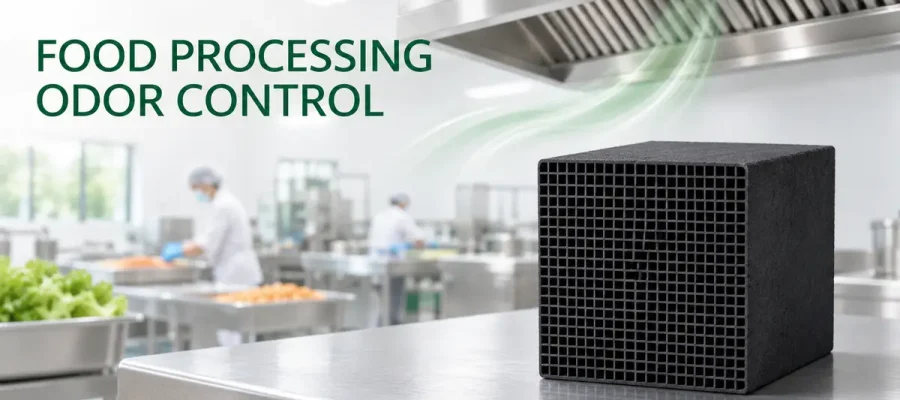
Food processing facilities can produce a wide range of odors during cooking, baking, frying, seasoning, and other production activities. Depending on the process, these odors may affect the working environment or cause concerns for nearby communities.
Honeycomb activated carbon can be used as part of an air treatment system to help reduce suitable odor-causing compounds in exhaust air. However, effective odor control requires more than simply installing carbon blocks. The composition and condition of the exhaust gas must also be considered.
In this article, we look at how honeycomb activated carbon can be applied in food processing odor control and what to consider before choosing a solution.
Where Do Food Processing Odors Come From?
Odors can be generated at different stages of food production. Their characteristics vary according to the raw materials, processing temperature, cooking method, and production schedule.
| Processing Activity | Possible Exhaust Characteristics |
|---|---|
| Frying and roasting | Cooking odors, oil mist, heat, and airborne particles |
| Baking | Odors from heated ingredients and production processes |
| Seasoning production | Strong odors that vary with ingredients and formulations |
| Meat or seafood processing | Odors associated with raw materials and processing operations |
| Food waste handling | Odors from stored or decomposing organic materials |
These examples do not represent every facility. A single exhaust stream may contain several odor-causing substances, together with moisture, droplets, or particles.
How Does Honeycomb Activated Carbon Help Reduce Odors?
Honeycomb activated carbon contains a network of internal pores that provides surfaces for adsorption. As exhaust air passes through its channels, suitable gas-phase odor compounds can be captured on the activated carbon.
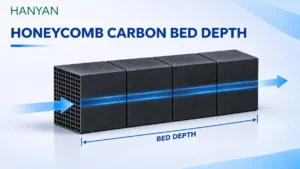
Its structured channels allow air to flow through the carbon blocks, while the modular block format makes it possible to arrange the carbon in layers according to the equipment design.
However, not all odor compounds are adsorbed equally. Performance depends on the type and concentration of the compounds, carbon properties, airflow, temperature, humidity, and other operating conditions.
Some gases may require a specially selected adsorbent or another treatment technology. For this reason, the exhaust gas should be evaluated before deciding whether honeycomb activated carbon is suitable.
Why Is Pretreatment Important?
Food processing exhaust may contain more than odor. Oil mist, dust, moisture, and heat can affect the performance of an activated carbon system.
1. Oil Mist and Grease
Exhaust from frying, roasting, and other cooking operations may contain oil droplets or grease. If these materials reach the carbon bed, they can accumulate on the surface or obstruct the channels.
Where oil mist is present, an appropriately designed grease or mist removal stage should be considered upstream of the carbon. The type of pretreatment depends on the amount and characteristics of the oil mist.
2. Dust and Airborne Particles
Food powders, smoke particles, and other suspended matter may accumulate in the honeycomb channels. Over time, this can increase airflow resistance and affect the amount of air passing through the system.
A suitable particle filtration stage can help reduce the amount of particulate matter reaching the activated carbon.
3. Temperature and Humidity
Hot or humid exhaust can influence adsorption performance. High humidity may reduce the capacity available for some odor compounds, while condensation can introduce liquid water into the system.
Depending on the application, the exhaust may need temperature control, moisture management, or both before it enters the carbon bed. The treatment method should be selected according to the actual operating conditions.
A Typical Food Processing Odor Control Process
A food processing exhaust system may include several stages, with each stage designed for a different purpose:
- Exhaust collection: Capture odor-containing air as close to the source as practical.
- Pretreatment: Remove or reduce oil mist, particles, or excess moisture when required.
- Honeycomb carbon adsorption: Pass the conditioned exhaust air through a suitable activated carbon bed.
- Monitoring and maintenance: Check operating conditions and replace the carbon when the selected performance limit is reached.
The actual process may differ. Some exhaust streams may require additional treatment or a different technology, depending on their composition and the required emission target.
What Should Be Considered When Selecting Honeycomb Carbon?
Before selecting honeycomb activated carbon for a food processing facility, consider the following questions:
- What process generates the odor?
- What are the main odor-causing substances, if known?
- What are the exhaust airflow rate and operating hours?
- Are oil mist, dust, or sticky particles present?
- What are the exhaust temperature and relative humidity?
- Is there a required outlet concentration or odor control target?
- How much space is available for the carbon bed and pretreatment?
- What pressure drop can the existing fan accommodate?
If the exhaust composition is unknown, on-site measurements or a representative sample test can help determine the suitability of the proposed adsorption solution.
How Can You Tell When the Carbon Needs Replacement?
Activated carbon has a limited working capacity. During operation, its ability to capture pollutants can gradually decline, and odor compounds may begin to appear at the outlet. This is commonly called breakthrough.
A noticeable odor at the outlet can be a warning sign, but relying only on smell is subjective and may not identify every problem. Depending on the application, a maintenance plan can include:
- Periodic checks of inlet and outlet conditions
- Monitoring airflow and pressure drop
- Checking the condition of pretreatment filters
- Testing target compounds or odor levels where appropriate
- Recording operating hours and carbon replacement dates
These records can help operators identify changes and plan future maintenance based on actual operating experience.
Honeycomb Activated Carbon Solutions from HANYAN
HANYAN supplies honeycomb activated carbon for air purification and industrial exhaust treatment. We understand that food processing applications can vary significantly in exhaust composition and operating conditions.
By reviewing your process information, airflow, target pollutants, and equipment requirements, our team can discuss suitable honeycomb activated carbon specifications and provide product selection support.
If you are evaluating an odor control project, contact us to discuss your application: enquiry@hanyancarbon.com
References
- U.S. Environmental Protection Agency, Overview of the Environmental Control Measures and Problems in the Food Processing Industries .
- U.S. Environmental Protection Agency, Air Pollution Control Cost Manual: Carbon Adsorbers .
- U.S. Environmental Protection Agency, Monitoring by Control Technique: Activated Carbon Adsorber .
Article Keywords: honeycomb activated carbon for odor control, food processing odor control, food factory odor treatment, honeycomb carbon odor filter, activated carbon for cooking odors, industrial odor removal, food processing exhaust treatment, activated carbon air purification