
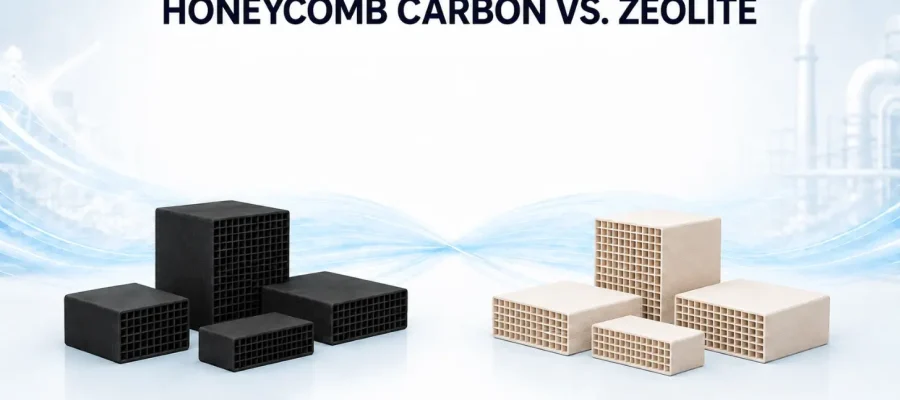
Honeycomb activated carbon and zeolite honeycomb are both used in industrial VOC treatment systems. Their similar channel structures allow large volumes of exhaust gas to pass through with relatively low resistance, but the two materials differ significantly in adsorption characteristics, operating conditions, regeneration requirements and cost.
Neither material is universally better for every application. The right choice depends on the VOC composition, concentration, airflow, humidity, temperature and system design. Understanding these differences can help equipment manufacturers and industrial users select a more suitable adsorption material.
What Is Honeycomb Activated Carbon?
Honeycomb activated carbon is generally produced from activated carbon powder, binders and other functional materials. It is formed into blocks containing multiple straight-through channels and then processed to develop its internal pore structure.
The combination of an activated carbon pore network and an organized honeycomb structure provides several practical advantages:
- Broad adsorption capability for many organic vapors
- Relatively low pressure drop in large-air-volume systems
- Convenient modular installation and replacement
- Different CTC values and formulations for different VOC conditions
- Customizable dimensions, CPSI and water-resistant properties
Honeycomb activated carbon is commonly used for low-concentration VOC treatment, industrial odor control and gas-phase purification in printing, coating, electronics, chemical processing and other industries.
What Is Zeolite Honeycomb?
Zeolite is a crystalline aluminosilicate material with relatively uniform pores. When manufactured as a honeycomb structure, it can be used as an adsorbent or concentration medium in industrial VOC treatment equipment.
Zeolite honeycombs are often associated with systems that require repeated adsorption and high-temperature desorption. Different zeolite formulations have different pore sizes, surface properties and VOC selectivity, so performance depends strongly on whether the selected zeolite matches the target compounds.
Honeycomb Activated Carbon vs. Zeolite Honeycomb
| Comparison | Honeycomb Activated Carbon | Zeolite Honeycomb |
|---|---|---|
| Adsorption range | Broad adsorption capability for many organic vapors and odors | More selective, depending on pore size and zeolite formulation |
| Typical operating temperature | Generally more suitable for normal-temperature or moderate-temperature adsorption | Usually offers greater thermal stability |
| Effect of humidity | High humidity may reduce usable VOC adsorption capacity | Hydrophobic zeolite grades can perform more consistently under humid conditions |
| Regeneration | Can be desorbed or replaced, depending on carbon grade and system design | Often selected for repeated high-temperature regeneration |
| Fire characteristics | Combustible material requiring proper temperature and concentration control | Non-combustible mineral material with higher thermal stability |
| Initial material cost | Usually more economical and easier to replace | Generally requires a higher initial investment |
Differences in VOC Adsorption
Activated carbon has a complex network of micropores, mesopores and larger transport pores. This enables it to adsorb a relatively broad range of organic compounds, particularly many medium- and high-molecular-weight VOCs commonly found in industrial exhaust.
Zeolite has a more uniform crystalline pore structure. This can provide useful selectivity, but VOC molecules must be compatible with the pore size and surface characteristics of the selected zeolite. A zeolite grade that performs well for one compound may not provide the same result for a different or more complex VOC mixture.
For this reason, gas composition should be reviewed before either material is selected. The presence of mixed solvents, poorly adsorbable compounds or chemically reactive gases may require testing or a specially designed treatment process.
How Humidity and Temperature Affect Selection
Humidity and temperature are important because adsorption performance measured under laboratory conditions may differ from performance in an operating factory.
High humidity can allow water vapor to compete with VOC molecules inside the pore structure of standard activated carbon. For humid gas streams, moisture control, demisting or water-resistant honeycomb activated carbon may be considered.
Some hydrophobic zeolite formulations are less affected by humidity and may be more suitable for repeated adsorption and desorption under demanding conditions. However, their effectiveness still depends on the target VOC and the specific zeolite formulation.
Temperature is another major factor. VOC adsorption on activated carbon generally becomes less favorable as the gas temperature rises. Zeolite offers greater thermal stability and is often selected for systems involving repeated high-temperature regeneration.
Pressure Drop Depends on More Than the Material
Both materials can be manufactured in a straight-channel honeycomb structure, helping reduce airflow resistance compared with certain loose-media beds. However, pressure drop should not be judged by material type alone.
Actual resistance is also affected by:
- CPSI and channel dimensions
- Block depth and number of layers
- Airflow velocity
- Dust, oil mist and particle accumulation
- Block arrangement and sealing
These factors should be evaluated together during system design. Improper installation or blocked channels can increase resistance and reduce treatment performance regardless of which adsorption material is used.
When Should You Choose Honeycomb Activated Carbon?
Honeycomb activated carbon is often a practical option when the project involves:
- Low-concentration and large-air-volume VOC exhaust
- Normal-temperature or moderate-temperature operation
- A mixture of common organic vapors and industrial odors
- Requirements for relatively low airflow resistance
- Modular installation and convenient replacement
- A need to control initial equipment and material costs
It is especially suitable for many coating, printing, furniture, electronics, chemical and general industrial air-purification applications when the exhaust conditions are properly controlled.
When May Zeolite Honeycomb Be More Suitable?
Zeolite honeycomb may be considered when the system requires:
- Frequent high-temperature adsorption and desorption cycles
- Higher thermal stability
- Selective adsorption of specific VOC molecules
- Long-term use in a continuously regenerated system
- A non-combustible adsorption medium
However, the higher initial cost, regeneration energy requirement and VOC selectivity should be assessed as part of the complete system rather than considering the adsorbent alone.
Information to Confirm Before Selecting an Adsorbent
Before choosing honeycomb activated carbon or zeolite honeycomb, users should provide the following operating information:
- VOC composition and concentration
- Total airflow rate
- Operating temperature and humidity
- Presence of dust, oil mist or condensable substances
- Required outlet concentration or removal efficiency
- Continuous or intermittent operating schedule
- Adsorption-only or adsorption-desorption system design
- Available installation dimensions and pressure-drop limits
These details are more useful than comparing a single specification such as iodine value, CTC or specific surface area.
Conclusion
Honeycomb activated carbon and zeolite honeycomb have different strengths in industrial VOC treatment. Honeycomb activated carbon offers broad VOC adsorption, relatively low pressure drop, convenient installation and competitive material cost, making it suitable for many normal-temperature, low-concentration and large-air-volume applications.
Zeolite honeycomb provides greater thermal stability and can be advantageous in continuously regenerated systems or applications requiring selective adsorption. The final decision should be based on the actual gas composition and operating conditions rather than assuming that one material is always superior.
HANYAN supplies different grades and customized sizes of honeycomb activated carbon for VOC treatment and industrial air purification. Based on the customer’s airflow, VOC composition, temperature, humidity and equipment structure, our technical team can provide practical guidance for product selection and engineering installation.
Article Keywords: honeycomb activated carbon vs zeolite, activated carbon vs zeolite for VOC removal, honeycomb activated carbon for VOC treatment, zeolite honeycomb for VOC treatment, VOC adsorption material, industrial VOC treatment, activated carbon air purification, VOC removal system