
Honeycomb activated carbon is widely used for VOC control, industrial air purification and gas treatment because of its structured channels, low airflow resistance and convenient installation. However, even high-quality honeycomb activated carbon cannot perform effectively if part of the gas stream bypasses the carbon blocks.
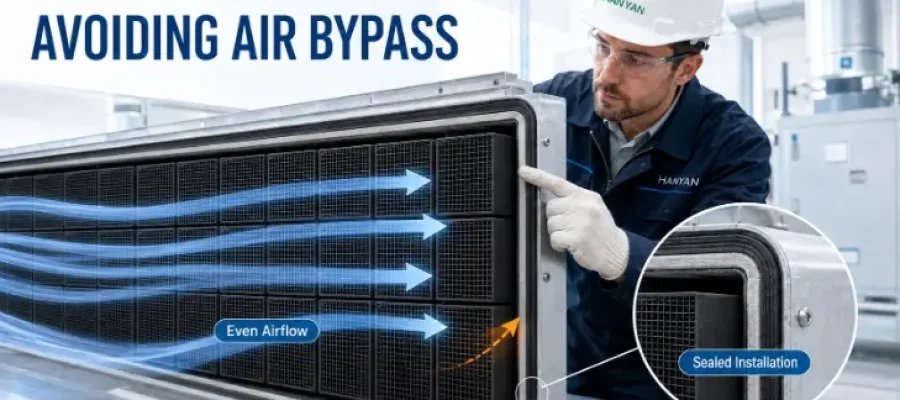
Air bypass usually occurs when there are gaps between the honeycomb blocks, insufficient sealing around the adsorption bed or an improper carbon block arrangement. Instead of flowing through the internal channels of the carbon, part of the untreated gas may pass through these gaps with limited contact time. This can reduce the overall adsorption efficiency of the system.
Why Does Air Bypass Occur?
Several installation and operating factors may contribute to air bypass:
- Gaps between adjacent honeycomb activated carbon blocks
- Inadequate sealing between the carbon blocks and equipment walls
- Irregular or unstable block arrangement
- Incorrect airflow direction
- Uneven airflow distribution inside the adsorption unit
- Movement or damage of carbon blocks during operation
Small installation gaps may appear insignificant, but air naturally follows the path of lower resistance. Therefore, even narrow spaces can allow part of the gas stream to avoid the honeycomb channels.
Arrange the Honeycomb Activated Carbon Blocks Properly
Honeycomb activated carbon blocks should be installed closely and evenly, without large gaps between them. Depending on the equipment design, a staggered arrangement may be used to reduce continuous straight gaps through the adsorption bed.
The blocks should also be properly supported to prevent movement, displacement or breakage during operation. Before installation, damaged blocks and loose carbon fragments should be removed to maintain a stable and uniform bed structure.
Pay Attention to Sealing
Effective sealing is essential around both the honeycomb blocks and the inner walls of the equipment. Suitable sealing materials can be used to close gaps while meeting the temperature and chemical-resistance requirements of the application.
Particular attention should be paid to the edges, corners and joints of the adsorption bed, as these areas are more likely to create bypass paths.
Ensure Uniform Airflow
The gas stream should enter the honeycomb channels as evenly as possible. If the inlet design causes the airflow to concentrate in only one area, some blocks may be overloaded while others are insufficiently utilized.
A properly designed air distribution section can help balance the airflow before it reaches the carbon bed. The honeycomb channels should also be aligned with the intended airflow direction to reduce unnecessary resistance and ensure sufficient contact between the gas and activated carbon.
Installation Quality Affects System Performance
Selecting the appropriate honeycomb activated carbon is only one part of an effective gas treatment system. Block arrangement, sealing, airflow distribution and routine inspection can all influence actual adsorption performance.
After installation, the system should be checked for visible gaps, loose blocks, damaged sealing materials and abnormal pressure changes. Regular inspection can help identify potential bypass problems before they significantly affect treatment efficiency.
With extensive experience in honeycomb activated carbon applications, HANYAN can provide practical technical guidance for product selection, block arrangement and engineering installation, helping customers improve airflow utilization and achieve more stable gas treatment performance.
Article Keywords: honeycomb activated carbon air bypass, honeycomb activated carbon installation, VOC control system, activated carbon sealing, industrial air purification, gas treatment system