
Gas-phase filtration plays an important role in industrial air purification, VOC removal, odor control, and clean air management. For many years, granular activated carbon has been one of the most common adsorbents used in gas treatment systems. It offers strong adsorption capacity and flexible application in many different industries.
However, as air purification systems continue to develop, more engineers and equipment manufacturers are paying attention to structured activated carbon media, especially honeycomb activated carbon. This trend is closely related to the demand for lower pressure drop, higher airflow efficiency, compact installation, and easier system integration.
Granular Activated Carbon: A Traditional and Reliable Choice
Granular activated carbon is widely used in gas-phase filtration because of its developed pore structure and good adsorption performance for many VOCs and odorous gases. It can be packed into filters, towers, adsorbers, and other treatment units.
For many projects, granular activated carbon remains a practical solution, especially when the system is designed with enough bed depth, contact time, and maintenance space. It is also suitable for applications where replacement, regeneration, or flexible loading is required.
However, granular carbon beds may create higher airflow resistance, especially in large-air-volume systems. If the packing is uneven, dust generation, channeling, and pressure drop changes may also affect long-term operation.
Why Honeycomb Activated Carbon Is Gaining Attention
Honeycomb activated carbon is designed with straight and uniform channels. This structure allows air to pass through the media more smoothly, helping reduce pressure drop compared with many packed-bed systems.
In gas-phase filtration, pressure drop is not only a technical parameter. It directly affects fan energy consumption, operating cost, and system stability. For large-air-volume VOC treatment systems, reducing airflow resistance can be an important advantage.
At the same time, honeycomb activated carbon has a compact block structure, which makes it easier to install in modular filter systems, air handling units, VOC adsorption boxes, and industrial purification equipment.
From Loose Media to Structured Media
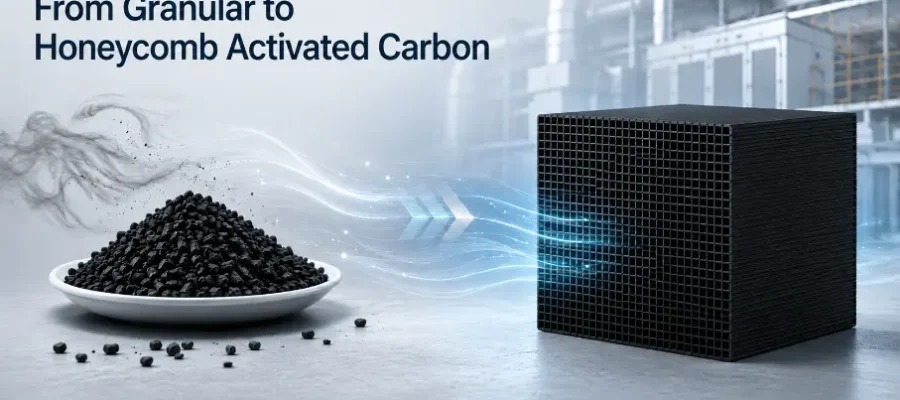
One important trend in gas-phase filtration is the movement from loose adsorbent media to structured adsorbent media. Traditional granular carbon relies on packed beds, while honeycomb activated carbon provides a more regular airflow path.
| Comparison Item | Granular Activated Carbon | Honeycomb Activated Carbon |
|---|---|---|
| Media Form | Loose granular particles | Structured honeycomb block |
| Airflow Path | Passes through packed particles | Passes through straight channels |
| Pressure Drop | Usually higher, depending on bed depth and particle size | Usually lower due to straight-channel structure |
| Installation | Requires packing, fixing, and anti-leakage design | Suitable for modular installation |
| Typical Use | Adsorption towers, carbon beds, filters | VOC filters, air purification boxes, modular gas-phase filtration systems |
Lower Pressure Drop and Energy-Saving System Design
Energy consumption is becoming an important consideration in modern air purification systems. When air passes through a filter or adsorbent bed, the fan must overcome system resistance. Higher pressure drop often means higher energy demand.
Honeycomb activated carbon can help reduce this resistance through its open and straight channel structure. This makes it especially useful in large-air-volume systems, where even a small reduction in pressure drop may contribute to long-term operating cost savings.
However, low pressure drop should not be considered alone. A good gas-phase filtration design still needs to balance airflow velocity, contact time, adsorption capacity, pollutant concentration, and replacement cycle.
More Suitable for Modular Air Purification Systems
Another trend is the increasing use of modular purification equipment. Many VOC and odor control systems now require easier installation, replacement, and maintenance. Honeycomb activated carbon fits this direction well because it can be manufactured into regular block sizes and installed in frames, boxes, or filter modules.
Compared with loose granular carbon, honeycomb blocks are easier to handle in some equipment designs. They can also help reduce dust movement and simplify the layout of gas-phase filtration units.
Applications in VOC and Odor Control
Honeycomb activated carbon is widely used in normal-temperature or controlled-temperature gas purification systems. It is suitable for many low-to-medium concentration VOC and odor control applications, such as:
- Painting workshops
- Printing facilities
- Electronics manufacturing
- Chemical storage areas
- Coating lines
- Industrial waste gas treatment systems
- Odor control projects
In these applications, the straight-channel structure of honeycomb activated carbon helps combine adsorption performance with airflow efficiency, making it a practical option for many industrial air purification projects.
Granular or Honeycomb: Which One Should Be Selected?
The choice between granular activated carbon and honeycomb activated carbon depends on the actual system conditions. Granular activated carbon is still suitable for many deep-bed adsorption systems and applications requiring high media loading volume.
Honeycomb activated carbon may be more suitable when the project requires low pressure drop, compact structure, large airflow treatment, modular installation, and easy replacement. It is not a complete replacement for granular carbon, but an important structured media option for modern gas-phase filtration design.
Conclusion
The development of gas-phase filtration is moving toward higher efficiency, lower energy consumption, easier maintenance, and more flexible system design. In this process, honeycomb activated carbon is becoming increasingly important.
While granular activated carbon remains a reliable and widely used adsorbent, honeycomb activated carbon offers clear advantages in low-pressure-drop and modular air purification systems. For VOC adsorption, odor control, and large-air-volume industrial gas treatment, honeycomb activated carbon provides a practical solution that meets the needs of many modern air purification projects.
At HANYAN, honeycomb activated carbon products can be customized according to different application requirements, including product size, cell density, adsorption performance, pressure drop, and target gas characteristics. By selecting the right activated carbon form at the early stage of system design, users can achieve more stable and efficient gas-phase filtration performance.
Article Keywords: gas-phase filtration, honeycomb activated carbon, granular activated carbon, activated carbon honeycomb, VOC adsorption, industrial air purification, odor control, low pressure drop activated carbon, gas phase filter media, VOC removal, modular activated carbon filter