
Spray booths are widely used in automotive parts production, furniture coating, metal finishing, electronics manufacturing, machinery painting, and other surface-coating processes. During spraying, drying, flash-off, and solvent cleaning, the exhaust air may contain volatile organic compounds (VOCs), odors, solvent vapors, and fine paint mist.
For many spray booth exhaust systems, honeycomb activated carbon is used as a compact adsorption material for VOC treatment. Its structured channels allow air to pass through in a straight direction, helping reduce airflow resistance while providing adsorption contact between the VOC-containing gas and the activated carbon surface.
However, selecting the right honeycomb activated carbon is only one part of the solution. Pretreatment, installation direction, airflow conditions, VOC concentration, and replacement planning can all affect actual operating performance.
Why Spray Booth Exhaust Requires VOC Treatment
Paints, coatings, thinners, solvents, and cleaning agents can release VOCs during coating operations. Depending on the process, these compounds may include aromatic solvents, esters, ketones, alcohols, and other organic vapors.
In addition to regulatory and environmental concerns, untreated spray booth exhaust may create strong odors, affect workplace conditions, and cause complaints from nearby areas. VOC treatment is therefore often an important part of the overall exhaust-gas management system.
Spray booths also commonly operate with relatively large airflow volumes. This means the selected VOC treatment material should provide useful adsorption performance without creating excessive pressure drop across the system.
Why Honeycomb Activated Carbon Is Used for Spray Booth VOC Treatment
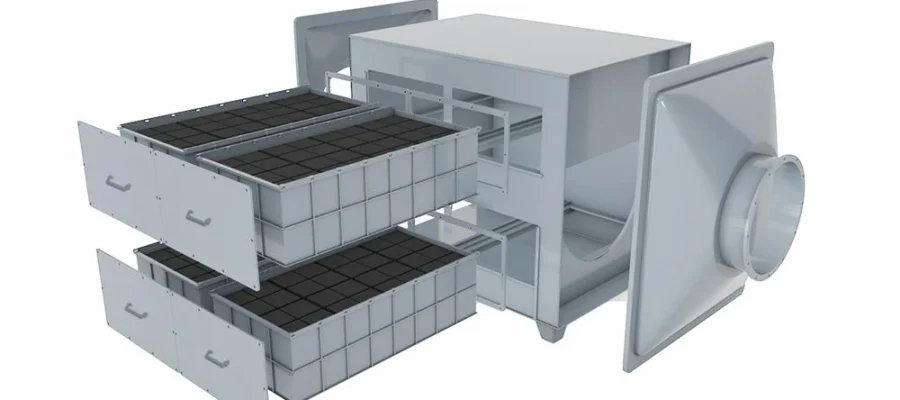
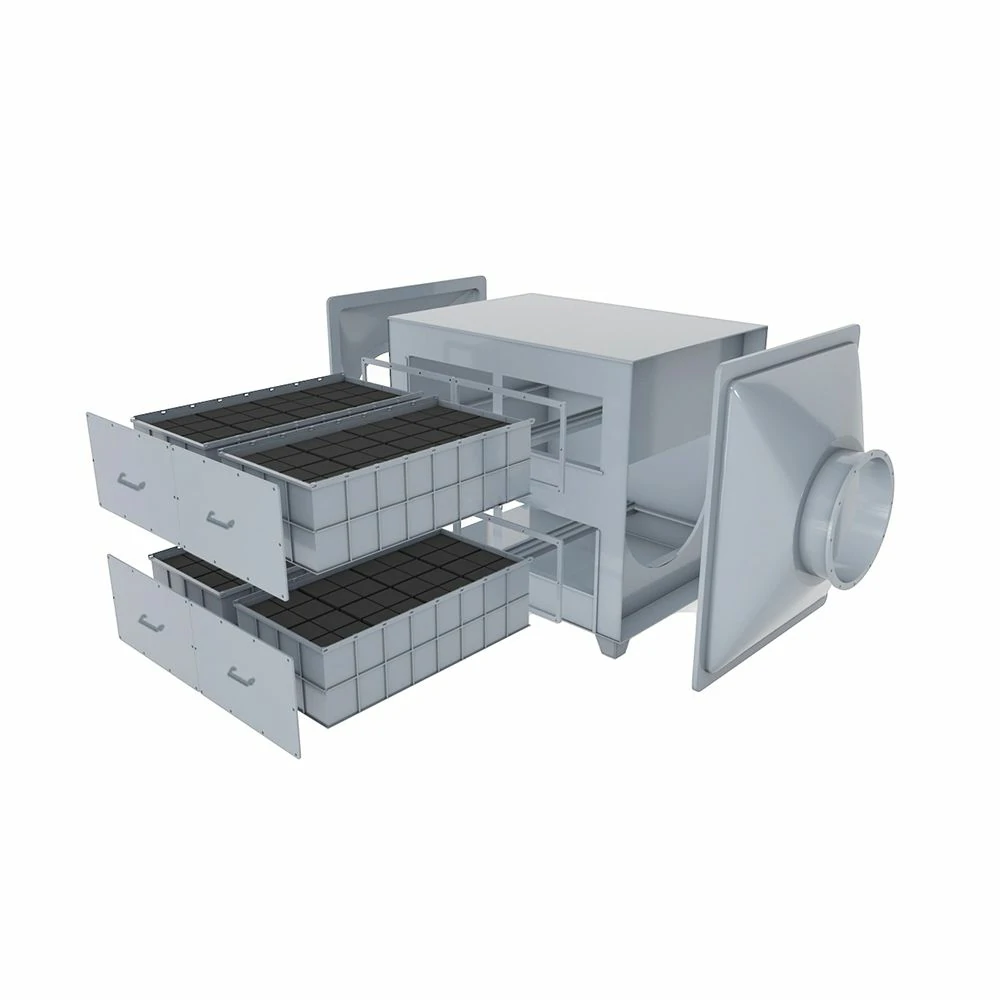
Honeycomb activated carbon is made with multiple straight-through channels. Compared with loose granular carbon beds, this structure can offer lower airflow resistance and easier installation in modular filter housings.
For spray booth VOC treatment, honeycomb activated carbon can provide several practical advantages:
- Structured channels for relatively low pressure drop
- Suitable for high-airflow exhaust systems
- Easy installation in frames, modules, or filter boxes
- Stable shape during handling and replacement
- Available in different cell densities, thicknesses, and adsorption grades
- Suitable for VOC and odor control applications after appropriate pretreatment
The honeycomb structure does not mean that every project can use the same grade. The carbon type, thickness, cell density, adsorption level, and installation area should be matched to the actual spray booth conditions.
Typical VOC Sources in Spray Booth Exhaust
The exact VOC composition depends on the coating system, production method, and solvent formulation. Common sources may include:
- Solvent-based paints and coatings
- Thinners and diluents
- Cleaning solvents
- Primer, topcoat, and clear-coat operations
- Drying and flash-off stages
- Paint mixing and transfer areas
In many cases, the exhaust stream contains not only VOC vapors but also paint mist, dust, oil aerosol, moisture, and other contaminants. These non-gaseous components can significantly affect the service life of honeycomb activated carbon if they are not controlled before the gas reaches the carbon layer.
How to Select Honeycomb Activated Carbon for a Spray Booth
1. Confirm the Main VOC Type
The first step is to understand what types of vapors are present in the exhaust. Different VOCs can have different adsorption behavior, and a general carbon grade may not be suitable for every mixed-gas condition.
When available, customers should provide information about paint type, solvent system, safety data sheets, VOC concentration, and whether the process includes special pollutants such as formaldehyde, acidic gases, alkaline gases, or high-boiling solvent vapors.
2. Consider Airflow Volume and Face Velocity
Spray booth systems often handle large air volumes. If the airflow passes too quickly through a carbon module, gas-contact time may become insufficient and VOC breakthrough can occur earlier.
A suitable design should consider total airflow, filter area, module quantity, carbon thickness, and face velocity. Increasing the available filtration area can help reduce airflow velocity through each honeycomb block and improve adsorption contact time.
3. Select Suitable Thickness and Cell Density
Honeycomb activated carbon is available in different thicknesses and cell densities. A thicker product generally provides a longer gas-flow path and more activated carbon available for adsorption, but it may also increase pressure drop.
Cell density is commonly expressed as CPSI, or cells per square inch. Higher CPSI products provide more channels within the same area, while lower CPSI products have larger channels. The suitable choice depends on airflow conditions, expected pressure drop, upstream dust level, and the overall system design.
For spray booth VOC treatment, the selection should balance adsorption capacity, airflow resistance, and the risk of channel blockage from paint mist or dust.
4. Confirm Adsorption Grade and Carbon Loading
Not all honeycomb activated carbon products have the same adsorption capacity. Carbon loading, internal pore structure, raw-material quality, and manufacturing process can all influence performance.
For VOC applications, buyers should confirm relevant adsorption indicators and discuss the main pollutant type with the supplier. A product selected only by appearance, cell density, or price may not provide the expected service life in actual spray booth operation.
Why Pretreatment Is Critical Before Honeycomb Activated Carbon
One of the most common reasons for early carbon replacement is insufficient pretreatment. Spray booth exhaust often contains paint mist, overspray particles, oil droplets, and dust. If these contaminants enter the honeycomb channels, they can block airflow passages and cover adsorption surfaces.
Once the channels are partially blocked, two problems may occur at the same time:
- Pressure drop increases and airflow becomes less stable.
- VOC adsorption efficiency decreases because less gas can contact the activated carbon effectively.
For this reason, honeycomb activated carbon is normally placed after suitable pretreatment stages. Depending on the process, these may include paint-mist filters, pre-filters, bag filters, high-efficiency particulate filters, demisters, or other collection systems.
For systems with oil mist or heavy aerosol loading, additional pretreatment may be necessary before the gas enters the activated carbon module.
Correct Installation Direction Matters
Honeycomb activated carbon should be installed so that the airflow passes through the straight channels, rather than across the side walls of the honeycomb block.
Correct airflow direction helps maintain a lower pressure drop and allows the gas to contact the activated carbon along the designed channel path. Incorrect installation may create unnecessary resistance, reduce usable filtration area, and affect the overall performance of the VOC treatment system.
When multiple modules are installed together, gaps between modules should also be minimized. Poor sealing can allow untreated gas to bypass the carbon layer, leading to lower overall removal efficiency even when the carbon itself is still active.
How to Identify When Honeycomb Activated Carbon Should Be Replaced
There is no single replacement schedule that applies to every spray booth. Actual service life depends on VOC concentration, airflow, operating hours, humidity, temperature, pretreatment efficiency, and the selected honeycomb carbon grade.
However, the following signs may indicate that replacement should be considered:
- VOC concentration at the outlet begins to increase.
- Solvent odor becomes noticeable after the carbon stage.
- Emission-monitoring results show reduced removal efficiency.
- Pressure drop rises significantly because of dust or paint-mist blockage.
- Operating hours approach the expected replacement cycle.
- Carbon modules show visible contamination, channel blockage, or oil deposition.
For more reliable operation, customers should monitor both outlet VOC performance and pressure drop. Focusing only on one of these indicators may overlook either adsorption breakthrough or physical blockage.
Factors That Can Shorten Service Life
Several operating conditions can cause honeycomb activated carbon to reach breakthrough earlier than expected:
- Sudden increases in solvent use or VOC concentration
- Insufficient pretreatment of paint mist, dust, or oil aerosol
- High humidity or water vapor competition
- Excessive airflow velocity through the carbon modules
- Insufficient carbon thickness or filtration area
- High operating temperature
- Air bypass caused by poor installation or module sealing
- Mixed pollutants that require a specialized or impregnated carbon grade
Understanding these factors can help users reduce unexpected replacement costs and improve the stability of the overall VOC control system.
Practical Information to Provide When Requesting a Quotation
To receive a more suitable honeycomb activated carbon recommendation for a spray booth project, buyers should provide as much of the following information as possible:
- Total exhaust airflow volume
- VOC concentration at the inlet
- Main paint, coating, and solvent types
- Operating temperature and humidity
- Existing pretreatment stages
- Available installation space and module dimensions
- Required pressure-drop limit
- Target outlet concentration or emission requirement
- Daily operating hours and expected replacement cycle
These details help determine the appropriate honeycomb size, thickness, CPSI, adsorption grade, and estimated module quantity for the project.
HANYAN Honeycomb Activated Carbon for Spray Booth Applications
HANYAN supplies honeycomb activated carbon for industrial VOC treatment and odor-control applications. For spray booth exhaust systems, we can support customers with honeycomb size selection, cell-density discussion, adsorption-grade recommendation, and customized module arrangements.
Our honeycomb activated carbon can be supplied for different VOC treatment conditions, including standard VOC adsorption, high-airflow systems, and projects requiring customized dimensions or carbon performance levels.
For customers experiencing early breakthrough, high pressure drop, or unstable odor-removal performance, discussing the full operating condition before selecting a replacement grade can help identify a more suitable solution.
Conclusion
Honeycomb activated carbon can be an effective part of a spray booth VOC treatment system when it is selected and installed correctly. Its structured-channel design can support high-airflow treatment with relatively low resistance, but real performance depends on more than the honeycomb block itself.
Article Keywords: VOC type, airflow volume, carbon thickness, adsorption grade, pretreatment efficiency, installation direction, and replacement monitoring should all be considered together. A well-matched honeycomb activated carbon system can help improve VOC control, reduce odor, and support more stable spray booth operation.