
In industrial VOC treatment, honeycomb activated carbon is often evaluated by product specifications, adsorption indicators, or past operating experience. However, actual field performance depends on more than the adsorbent alone. Humidity and temperature are two of the most important operating conditions that can significantly influence how honeycomb activated carbon performs in a real VOC system.
This is one reason why a carbon that looks suitable on paper may behave differently on site. Even when the same product is used, adsorption efficiency, breakthrough behavior, and service life may change when moisture levels rise or gas temperature shifts.
For industrial users, understanding these two factors is essential for more realistic carbon selection, system design, and replacement planning.
Why Operating Conditions Matter in VOC Adsorption
Activated carbon adsorption in VOC control is not a fixed value. According to EPA technical guidance, the amount of VOC adsorbed at equilibrium depends on the chemical species, pressure, and carbon characteristics, but also on adsorption temperature. In general, adsorptivity increases with VOC partial pressure and decreases as temperature rises.
In practical terms, this means that the same honeycomb activated carbon can show different results under different workshop environments, process temperatures, or seasonal conditions. A system that performs well in cooler and drier periods may become less stable during hot or humid operation.
How Humidity Affects Honeycomb Activated Carbon Performance
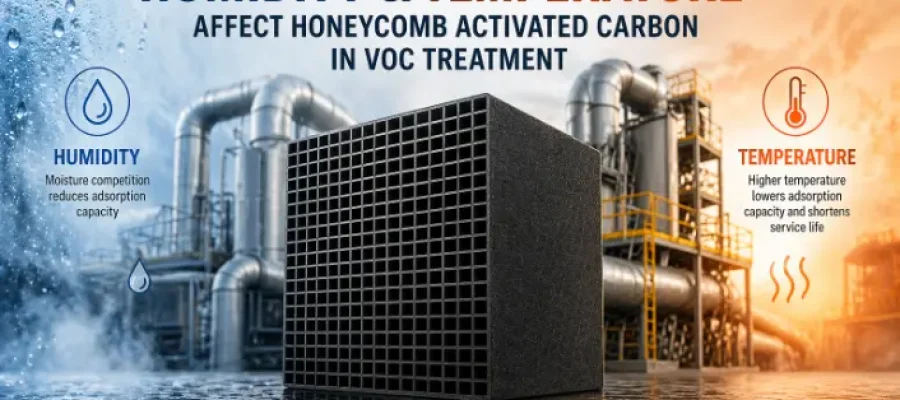
Humidity matters because activated carbon does not interact only with target VOCs. Water vapor is also present in many industrial gas streams, and activated carbon can adsorb water as well. When moisture is high, water molecules may compete with VOC molecules for available adsorption space, which can reduce effective adsorption capacity for the target pollutants.
1. Moisture can occupy adsorption sites
In humid air, part of the internal pore structure may become occupied by water vapor instead of VOC molecules. This reduces the working capacity available for the compounds the system is actually designed to remove. The result may be earlier breakthrough, reduced treatment stability, or a shorter replacement interval.
2. High humidity can make field performance less predictable
When humidity fluctuates significantly, outlet performance can become less stable even if the inlet VOC load does not appear to change much. In some cases, operators may observe that the carbon performs well in one season but more poorly in another. This difference is often related not to product inconsistency, but to changing gas conditions.
3. Moisture can make pretreatment more important
If the gas stream contains high humidity together with particulate matter, mist, or condensable components, the effect on the adsorption bed can be even more severe. Under these conditions, pretreatment design becomes critical. Moisture control, demisting, and particle removal may all help protect the honeycomb structure and preserve usable pore volume. Camfil’s technical guidance on gaseous filtration similarly notes that activated carbon can adsorb water vapor and that particle contamination can seal the outer surface, making internal pores less accessible.
How Temperature Affects VOC Adsorption
Temperature is another key factor because adsorption is generally less favorable at higher temperatures. EPA references on carbon adsorbers and VOC recapture controls both note that equilibrium adsorptivity decreases with increasing temperature. This means that when the gas stream becomes hotter, the carbon may hold less VOC at a given concentration than it would under cooler conditions.
1. Higher temperature can reduce adsorption capacity
As temperature rises, VOC molecules are less easily retained on the carbon surface. In practical operation, this can shorten the effective service life of the honeycomb activated carbon bed and move breakthrough forward.
2. Hot gas streams may require additional design attention
In industrial systems, VOC emissions are not always released at a stable ambient temperature. Some processes generate relatively warm exhaust, while others have temperature peaks during startup or production changes. If carbon is selected only by static product data without considering the actual gas temperature, field performance may fall below expectations.
3. Cooling may improve adsorption conditions
Older EPA technical material on VOC recovery notes that effective carbon adsorption generally benefits from cooler gas conditions and lower relative humidity. This does not mean every system needs aggressive cooling, but it does show why temperature control or process stabilization may improve overall adsorption performance.
Why Lab Data and Field Results Are Not Always the Same
One common misunderstanding is to assume that a favorable technical data sheet guarantees the same result in every application. In reality, laboratory values are usually obtained under more controlled conditions than industrial exhaust systems.
Actual VOC treatment conditions may involve:
- changing humidity levels
- temperature fluctuations
- mixed VOC components
- intermittent concentration spikes
- dust, oil mist, or condensable vapors
- variation in airflow and contact time
Because of this, adsorption performance should be interpreted as a system result rather than a material number alone. The carbon, the contaminant profile, the pretreatment stage, and the operating environment all work together to determine real service behavior. EPA guidance also notes that VOC removal efficiency depends on multiple factors including the specific VOC constituents, the type of carbon used, and the physical properties of the system.
Practical Risks in High-Humidity or High-Temperature Conditions
When humidity or temperature is not properly considered, several practical problems may appear in VOC treatment systems:
- Shorter carbon life – replacement is needed sooner than expected.
- Earlier breakthrough – outlet concentration rises faster under real operating conditions.
- Reduced stability – the system performs differently across seasons or production periods.
- Higher operating cost – more frequent replacement or maintenance is required.
- Misjudgment of product quality – users may blame the carbon itself when the main issue is actually process condition.
These risks are especially relevant in systems with fluctuating loads, insufficient front-end pretreatment, or exhaust streams that are close to saturation with water vapor.
What Industrial Users Should Evaluate in Practice
When selecting or assessing honeycomb activated carbon for VOC treatment, it is useful to look beyond the product specification sheet and ask a few practical questions:
1. What is the actual humidity range of the gas stream?
If the exhaust is regularly humid, moisture competition may become part of the adsorption reality rather than an occasional issue.
2. Is the gas temperature stable or does it fluctuate?
Temperature spikes during startup, shutdown, or process switching may reduce adsorption margin even if average conditions appear acceptable.
3. Is there adequate pretreatment?
Filters, demisters, or cooling stages may be necessary to improve the working environment for the carbon bed.
4. Is the replacement cycle based on real operating records?
Tracking outlet trends, odor return, seasonal behavior, and operating conditions can provide a much better basis for replacement timing than a fixed calendar alone.
5. Is the application evaluated as a system, not only as a material purchase?
In many projects, improving humidity control or stabilizing the gas condition may be just as important as changing the carbon grade.
Conclusion
Humidity and temperature can have a major influence on honeycomb activated carbon performance in VOC treatment. High humidity may reduce available adsorption capacity by introducing moisture competition, while elevated temperature generally makes VOC adsorption less favorable and can shorten effective service life.
For this reason, industrial users should avoid evaluating honeycomb activated carbon only by isolated specification values. A more realistic approach is to consider the actual gas stream, seasonal or process variation, pretreatment condition, and operating stability as part of the adsorption decision.
In VOC control, better performance usually comes from matching the carbon to the real working environment – not from assuming that one set of laboratory numbers will apply equally under all field conditions.
Article Keywords: honeycomb activated carbon VOC treatment, humidity effect on activated carbon, temperature effect on activated carbon, VOC adsorption conditions, industrial VOC control, honeycomb carbon performance, moisture impact on adsorption, activated carbon system design