
In the honeycomb activated carbon market, CTC is one of the most familiar numbers buyers ask about. A higher CTC value is often taken as a sign of better adsorption performance, and in many cases, it does reflect a higher activation level and stronger vapor-phase adsorption potential.
But when a project moves from the lab to a real industrial system, a common misunderstanding appears: many people assume that a higher CTC automatically means a longer service life.
In practice, that conclusion is too simplistic.
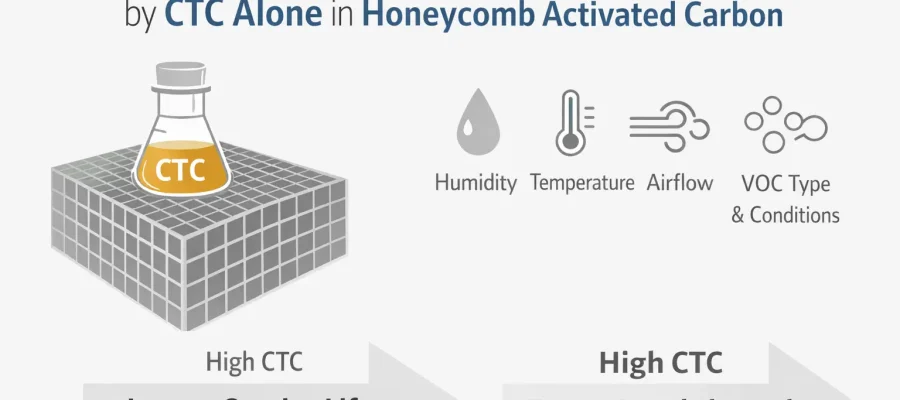
For honeycomb activated carbon used in VOC treatment, service life is not determined by CTC alone. It is shaped by the interaction between carbon properties, VOC characteristics, operating conditions, and system design. That is why two products with similar CTC values may show very different replacement cycles in actual use.
What CTC Can Tell You
CTC, or carbon tetrachloride activity(CCL4), is widely used as an indicator of activation level in vapor-phase activated carbon. In simple terms, it helps show whether the carbon has developed sufficient pore volume to adsorb gas-phase molecules.
For this reason, CTC is a useful specification when comparing honeycomb activated carbon products intended for air purification, solvent-related applications, or VOC control systems. It provides a quick quality reference and can help screen out products with insufficient activation.
So yes, CTC matters.
But CTC is still a controlled laboratory indicator. It does not fully represent how a carbon block will behave under fluctuating temperature, mixed VOC streams, humid air, or different airflow conditions inside a real industrial unit.
What CTC Cannot Tell You
CTC alone cannot answer the most practical question buyers care about: how long will the honeycomb activated carbon actually last in my system?
That is because service life is not just about how much adsorption capacity exists under standard test conditions. It is also about how quickly that capacity is consumed in the real process.
A carbon with a high CTC may still reach breakthrough faster if:
- the VOC concentration is higher than expected,
- the gas stream contains moisture that competes for adsorption sites,
- the target compounds are difficult to adsorb,
- the air velocity is too high,
- the contact time is too short,
- or the system experiences unstable operating loads.
In other words, CTC reflects one part of the material story, while service life depends on the full operating story.
Six Factors That Strongly Influence Real Service Life
1. VOC Composition
Not all VOCs behave the same way on activated carbon. Molecules differ in size, polarity, volatility, and adsorption affinity. A carbon block that performs well for one solvent mixture may not show the same life when the emission profile changes.
This is especially important in mixed gas streams. Even when total VOC concentration looks manageable, competitive adsorption between compounds can change the breakthrough pattern significantly.
2. VOC Concentration
Service life is closely tied to the actual contaminant loading entering the system. Even a good honeycomb carbon cannot maintain the same replacement interval if inlet concentration rises, peak loads become frequent, or process emissions become unstable.
That is why projects with strong seasonal variation or batch production often see shorter real-life cycles than expected from static lab thinking.
3. Humidity
Humidity is one of the most underestimated factors in vapor-phase adsorption. When moisture is high, water can occupy adsorption sites and reduce the effective working capacity available for VOCs.
This means a carbon with a strong CTC result may still perform below expectation if the incoming gas is wet, especially when VOC concentration is relatively low and water competition becomes more obvious.
4. Temperature
Adsorption capacity generally decreases as temperature rises. In practical terms, the same honeycomb activated carbon may last longer in a cooler gas stream and shorter in a hotter one, even if all other parameters are similar.
This is why service life estimates based only on product data sheets can be misleading when inlet temperatures in the real system are higher than the test assumptions behind the original evaluation.
5. Airflow and Contact Time
Even high-quality carbon needs enough contact opportunity with the gas stream. If face velocity is too high or residence time is too short, breakthrough may occur earlier than expected.
For honeycomb activated carbon, system geometry, channel structure, module arrangement, and total airflow all affect whether the carbon’s potential is actually translated into usable adsorption performance.
6. System Design and Maintenance
Service life is also influenced by what happens around the carbon, not only inside it. Poor pre-filtration, uneven airflow distribution, leakage, temperature spikes, or delayed replacement schedules can all shorten effective operating life.
In some projects, the carbon is blamed too quickly when the root cause is actually upstream dust loading, moisture carryover, or system imbalance.
Why Two Carbons with Similar CTC Can Behave Very Differently
Imagine two honeycomb activated carbon products both showing strong CTC values in the lab.
Product A is installed in a relatively dry system treating stable aromatic VOCs at moderate temperature and controlled airflow.
Product B is installed in a humid process stream with variable solvent composition, intermittent concentration peaks, and insufficient contact time.
Even if both products look similar on paper, their replacement cycles may differ greatly in real operation.
This is exactly why experienced engineers do not use CTC as a direct service-life calculator. They treat it as one indicator among several, not as a standalone answer.
A Better Way to Evaluate Honeycomb Activated Carbon
If the goal is to estimate real service life more accurately, buyers should evaluate honeycomb activated carbon through a broader engineering lens.
In addition to CTC, it is useful to review:
- target VOC type and concentration range,
- humidity and operating temperature,
- airflow and face velocity,
- expected contact time,
- pressure drop requirements,
- dust and pretreatment conditions,
- whether the system works under stable or fluctuating loads,
- and whether replacement or regeneration strategy has been considered from the start.
When possible, product selection should be based on both lab data and application-specific judgment. In more demanding projects, pilot testing or historical operating feedback may be far more valuable than relying on a single specification number.
What Buyers Should Ask Instead of Only Asking for CTC
Instead of asking only “What is the CTC value?”, a better technical discussion would include questions such as:
- What VOCs is this honeycomb carbon designed to handle?
- How does it perform under higher humidity conditions?
- What airflow range is suitable for this structure?
- What is the expected service life under similar project conditions?
- Has this grade been used in comparable industries or solvent systems?
- What operating assumptions were used when estimating replacement frequency?
These questions move the conversation away from a single number and toward actual application fit.
Conclusion
CTC is important, but it is not the same as service life.
For honeycomb activated carbon in VOC applications, CTC can help indicate activation quality and vapor-phase adsorption potential. However, real replacement cycles depend on a wider set of variables, including VOC chemistry, concentration, humidity, temperature, airflow, contact time, and system design.
That is why selecting honeycomb activated carbon should never be reduced to choosing the product with the highest CTC number on a data sheet.
The better approach is to treat CTC as one useful reference within a full engineering evaluation. In real projects, performance is defined not by a single laboratory figure, but by how well the carbon matches the actual operating conditions.
If you are evaluating honeycomb activated carbon for a VOC control system, focusing on application fit will usually lead to a better outcome than focusing on CTC alone.
Article Keywords: honeycomb activated carbon, CTC, carbon tetrachloride activity, honeycomb carbon service life, VOC adsorption, industrial air filtration, activated carbon for VOC treatment, honeycomb carbon replacement cycle