
Structural Design, Airflow Behavior & Performance Optimization
Honeycomb activated carbon filters are widely used in industrial gas-phase filtration systems for VOC control, odor removal, and chemical adsorption. However, real-world performance depends on more than a single parameter. Structural design, airflow behavior, and operating conditions interact to determine adsorption efficiency and service life.
This engineering guide consolidates key technical principles behind honeycomb activated carbon performance and connects three essential topics: pressure drop, CPSI, and face velocity.
1. Pressure Drop vs Adsorption Performance
Pressure drop describes airflow resistance through the honeycomb structure. While low resistance reduces fan energy consumption, it does not automatically guarantee high adsorption efficiency.
Understanding the relationship between airflow resistance and mass transfer is critical for avoiding premature breakthrough.
Read the full article: Pressure Drop vs Adsorption Performance in Honeycomb Activated Carbon Filters
2. Why CPSI Alone Cannot Define Performance
CPSI (cells per square inch) defines channel density, but it does not determine adsorption capacity, contact time, or carbon utilization. Two filters with identical CPSI can behave very differently under varying operating conditions.
Structural parameters must always be evaluated alongside airflow rate and filter depth.
Read the full article: Why CPSI Alone Cannot Define Honeycomb Activated Carbon Performance
3. How Face Velocity Determines Breakthrough Time
Face velocity directly affects residence time and adsorption kinetics. Excessive airflow speed can shorten breakthrough time even when carbon quality and CPSI remain constant.
Optimizing velocity is often more important than adjusting structural density alone.
Read the full article: How Face Velocity Determines Breakthrough Time in Honeycomb Activated Carbon Filters
System-Level Engineering Perspective
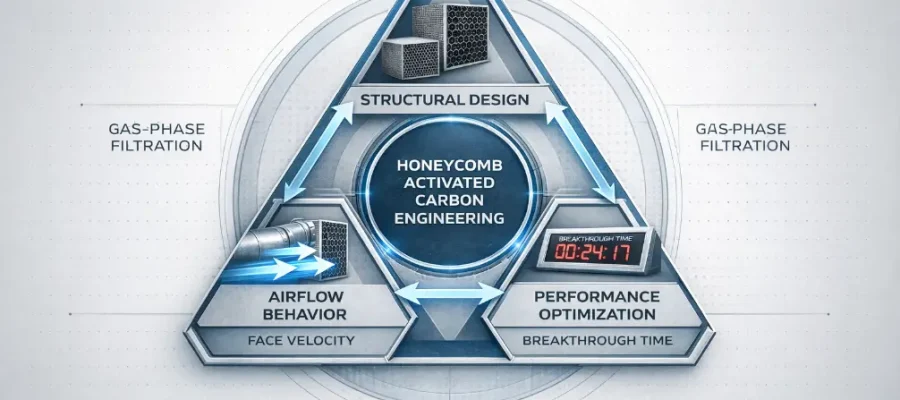
Effective honeycomb activated carbon design requires balancing:
- CPSI (channel density)
- Filter depth
- Face velocity
- Pressure drop
- Target service life
Rather than optimizing a single parameter, engineers should evaluate the entire system – airflow distribution, contaminant load, and operational stability – to achieve predictable long-term performance.
Article Keywords: honeycomb activated carbon engineering, CPSI, pressure drop, face velocity, breakthrough time, gas phase filtration design, industrial air filtration optimization