
CPSI (cells per square inch) is one of the most frequently quoted parameters when discussing honeycomb activated carbon filters. In many specifications and comparison tables, CPSI is often treated as a shorthand indicator of performance, efficiency, or even adsorption capacity.
However, in real industrial gas-phase filtration systems, CPSI alone cannot define how a honeycomb activated carbon filter will perform. Relying on this single structural parameter can lead to incorrect design decisions, unrealistic expectations, and inconsistent operating results.
This article explains why CPSI should be viewed as a design variable, not a performance guarantee, and how it interacts with other critical factors in honeycomb activated carbon applications.
1. What CPSI Actually Represents
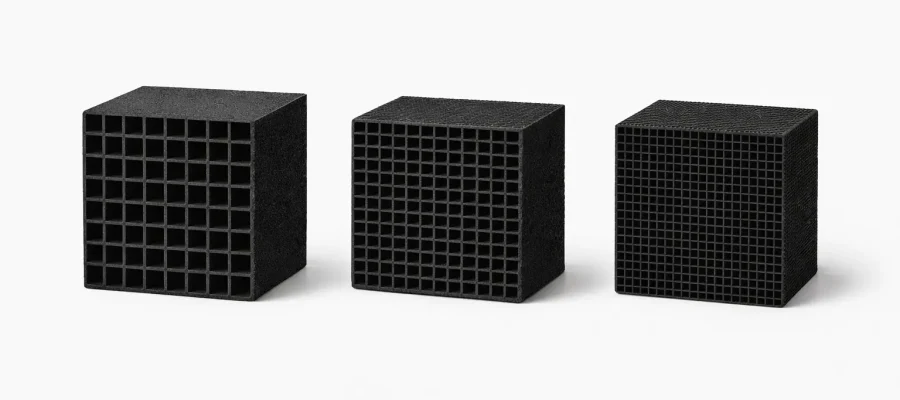
CPSI refers to the number of open channels per square inch on the cross-section of a honeycomb structure. In general terms:
- Higher CPSI → smaller individual channels
- Lower CPSI → larger individual channels
CPSI mainly describes geometric structure. It does not directly measure adsorption capacity, surface chemistry, pore size distribution, or carbon quality.
(cr.) In gas-phase filtration engineering, honeycomb geometry affects flow distribution and resistance, but adsorption performance still depends on media properties and operating conditions.
2. CPSI and Pressure Drop: A Coupled Relationship
One of the most visible effects of CPSI is its influence on pressure drop:
- Higher CPSI typically increases airflow resistance
- Lower CPSI generally reduces pressure drop
However, pressure drop itself is not a direct indicator of adsorption efficiency. Resistance reflects airflow behavior, while contaminant removal requires sufficient mass transfer and residence time.
(cr.) ASHRAE provides technical guidance on filtration and air cleaning as a system-level topic, emphasizing that expected performance depends on how air actually moves through and around the installed media.
(cr.) Source: ASHRAE – Filtration / Disinfection (technical resources) .
3. CPSI Does Not Define Contact Time
A common misconception is that higher CPSI automatically results in better adsorption due to “more surface area.” In reality, CPSI does not define:
- Filter depth
- Face velocity
- Gas residence time
Two honeycomb filters with the same CPSI can have completely different contact times if they operate at different airflow rates or use different filter depths. Adsorption efficiency is closely tied to how long target molecules remain in contact with the carbon surface.
(cr.) Adsorption performance is strongly influenced by operating conditions; insufficient residence time can reduce effective carbon utilization, even if the geometry looks “denser.”
4. CPSI vs Carbon Utilization Efficiency
CPSI also does not reflect how effectively the activated carbon is used during operation. Factors such as:
- Carbon wall thickness
- Carbon density and loading
- Pore accessibility and diffusion pathways
all influence how much of the carbon’s internal surface area participates in adsorption. A higher CPSI structure with thin walls and limited carbon mass may saturate faster than a lower CPSI design with greater effective carbon loading.
(cr.) Real performance needs to be evaluated using standardized approaches for gas-phase media/devices rather than relying on a single structural parameter.
5. Why CPSI-Only Comparisons Are Misleading
Using CPSI as a standalone comparison metric can result in:
- Overestimating adsorption efficiency
- Ignoring breakthrough behavior
- Underestimating replacement frequency
- Poor alignment with real operating conditions
This is especially problematic in industrial environments where airflow rates, contaminant composition, and concentration levels vary significantly.
6. What to Reference Instead: Standards and Test Methods
If you want apples-to-apples comparisons, CPSI should be reviewed together with performance data generated from recognized test methods for gas-phase air cleaning media and devices.
(cr.) ASHRAE Standard 145.2 prescribes a laboratory test method for measuring the performance of in-duct sorptive media gas-phase air-cleaning devices.
(cr.) Source: ANSI/ASHRAE Standard 145.2 (webstore overview) .
(cr.) ISO 10121-1 describes a test method for assessing the performance of gas-phase air cleaning media for general ventilation applications.
(cr.) Source: ISO 10121-1:2014 — Gas-phase air cleaning media .
7. How to Choose the Right CPSI for Honeycomb Activated Carbon
CPSI (Cells Per Square Inch) is a critical design factor for honeycomb activated carbon filters, it impacts airflow resistance, adsorption efficiency, and mechanical strength, and provides practical guidelines for selecting the optimal structure for different applications. Click here to see how to choose the right CPSI for honeycomb activated carbon.
Conclusion
CPSI is an important structural parameter, but it cannot define honeycomb activated carbon performance on its own. Adsorption efficiency, service life, and real-world effectiveness depend on how CPSI interacts with airflow, contact time, carbon loading, and operating conditions. Treating CPSI as a design variable – rather than a performance shortcut – leads to more reliable and predictable filtration outcomes.
Article Keywords: honeycomb activated carbon, CPSI, adsorption performance, pressure drop, gas phase filtration, contact time, industrial air filtration, carbon utilization, breakthrough behavior