
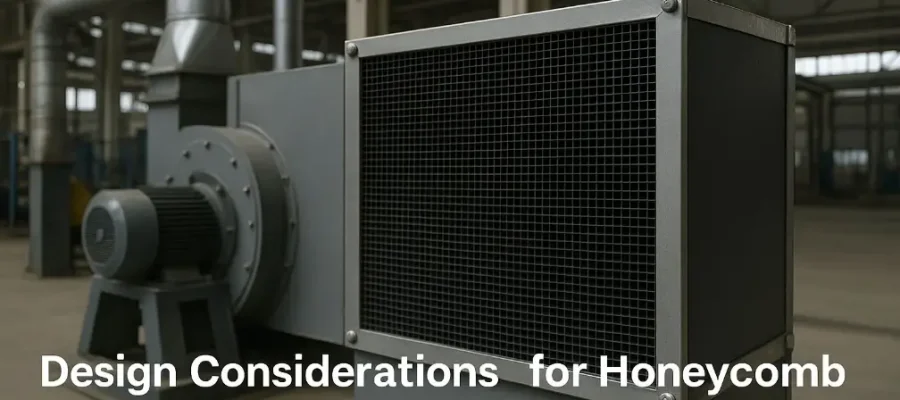
Honeycomb activated carbon filters are widely used in VOC treatment, solvent recovery, odor removal, air purification, and emissions control. Their structured geometry, large surface area, and low-pressure-drop design make them ideal for industrial systems requiring continuous and efficient gas-phase adsorption.
This article outlines the essential design considerations engineers should evaluate when integrating honeycomb activated carbon filters into industrial equipment.
1. Selecting the Right Activated Carbon Material
The foundation of a high-performance filter begins with choosing the appropriate activated carbon. The main options include:
| Carbon Type | Characteristics | Typical Applications |
|---|---|---|
| Coconut shell activated carbon | High hardness, strong microporosity | Air purification, solvent adsorption |
| Coal-based activated carbon | Balanced micropores and mesopores | General gas purification, VOC removal |
| Wood-based activated carbon | High mesopores and macropores, fast adsorption kinetics | Odor control, large-molecule adsorption |
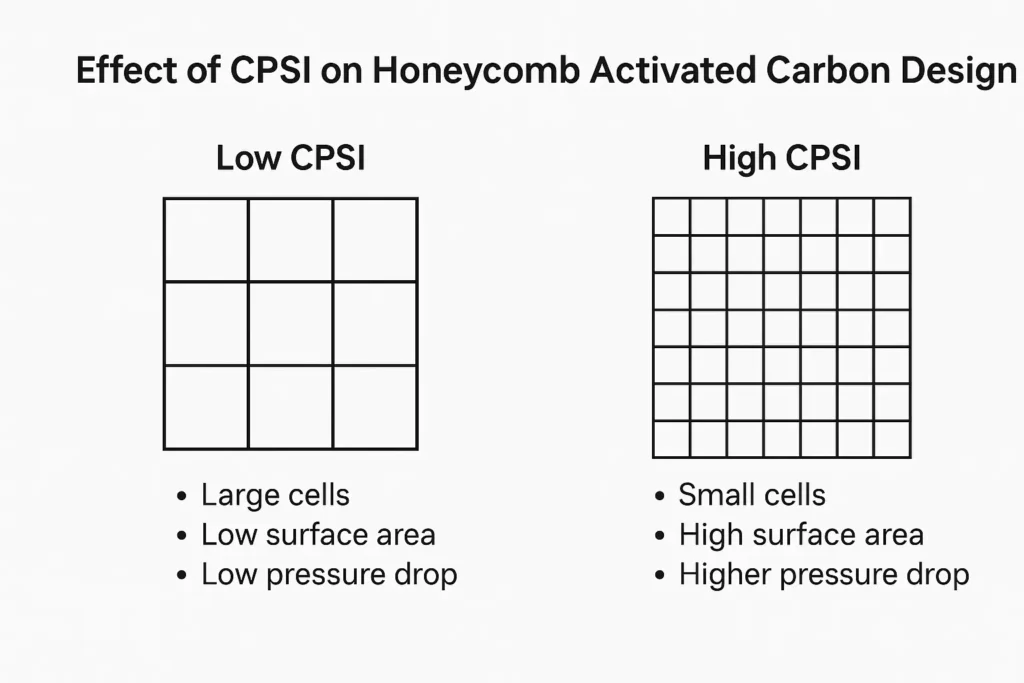
2. Determining CPSI (Cells Per Square Inch) & Wall Thickness
CPSI and wall thickness directly affect:
- Adsorption efficiency
- Air resistance
- Strength and durability
- Regeneration capability (if applicable)
| CPSI | Advantages | Considerations |
|---|---|---|
| 100 CPSI | Low pressure drop, strong structure | Lower surface area per volume |
| 150–200 CPSI | Balanced adsorption & airflow | Widely used in industrial systems |
| 300 CPSI+ | Higher contact area, faster adsorption | Higher pressure drop and fragility |
Most industrial equipment adopts 100–150 CPSI as a balance between efficiency and airflow resistance. Learn more to know how to choose the right CPSI for honeycomb activated carbon.
3. Airflow Direction & Pressure Drop Evaluation
Honeycomb filters are designed for straight-through airflow. When designing the system:
- Ensure uniform airflow distribution
- Avoid high-velocity impact zones
- Maintain sufficient distance from blowers
- Prevent by-pass leakage with proper sealing
The pressure drop must be calculated based on:
- Filter size and depth
- CPSI
- Gas velocity
- Stacking layers (single or multi-layer)
Low pressure drop is one of the core advantages of honeycomb activated carbon, allowing higher airflow at lower energy cost.
4. Filter Module Size and Structural Design
Common module sizes include:
- 100×100×100 mm
- 100×100×50 mm
- Customized dimensions based on equipment
Key considerations when selecting module size:
- Does the module fit the filter frame?
- Is additional sealing tape or gasket required?
- How many modules are needed to fill the equipment?
- Will maintenance require single-block replacement or full-module replacement?
5. Sealing, Framing and Installation
Sealing is critical to prevent bypass leakage. A poorly sealed filter significantly reduces adsorption efficiency.
Engineers should consider:
- EPDM or silicone gaskets for high-temperature systems
- Aluminum or galvanized frames for corrosion resistance
- Front-loading vs. side-loading installation structure
- Compression force required to ensure airtight sealing
Proper sealing may increase the total efficiency by more than 20% in some systems.
6. Operating Environment & Lifetime Expectations
Honeycomb activated carbon performance is affected by:
- Gas concentration
- Humidity
- Temperature
- Presence of corrosive gases (e.g., SO₂, HCl, NH₃)
- Continuous vs. intermittent operation
Typical lifetime ranges from 6–24 months depending on load. For high-humidity or acidic gas environments, special impregnated carbon may be required.
7. Maintenance, Regeneration, or Replacement Strategy
When designing the system, engineers should predetermine:
- Whether the carbon will be regenerated or replaced
- Module access locations for quick maintenance
- Pressure drop monitoring points
- End-of-life adsorption indicators (breakthrough concentration)
Many industrial VOC systems adopt modular replacement because it ensures stable performance and minimizes downtime.
Conclusion
Designing honeycomb activated carbon filters requires a balance of adsorption efficiency, airflow resistance, structural compatibility, and maintenance practicality. By selecting the correct material, CPSI, module size, sealing method, and operating conditions, engineers can achieve reliable and long-lasting performance in industrial gas treatment systems.
Article Keywords: honeycomb activated carbon, industrial air filtration, VOC treatment, CPSI design, pressure drop, activated carbon filter design, gas-phase adsorption, filter module engineering